This guide shares strategies for scaling consulting businesses to $1M+ via three business models: consulting firm, productized consulting, and customized consulting. It highlights the importance of strategic focus, true commitment, and decisive action. The article presents a four-step framework: eliminating low-value activities, utilizing contractor networks, building a qualified specialist bench, and productizing services. It also covers using AI, effective delegation, creating multiple revenue streams, and cultivating a CEO mindset for long-term, strategic growth.
Looking to scale your consulting business beyond where it is today? Perhaps you’ve built a steady stream of projects. You’re recognized in your industry. You might even be considering hiring someone to work with you. But you feel like you’re hitting a wall – maxed out on billing hours, drowning in day-to-day operations, and struggling to work on your business instead of just in it.
You want exponential growth, not just incremental improvements. You’re ready to transform your consulting practice into a scalable, profitable enterprise that can generate $1M or more in revenue.
The challenge? Most consultants approach scaling with the wrong mindset and strategies. They try to do everything themselves, avoid investing in their business, and jump from tactic to tactic without a coherent plan.
By the end of this guide, you’ll learn the proven frameworks, business models, and growth strategies that successful consultants use to scale to seven figures and beyond. You’ll discover how to leverage technology (including AI), build systems that work without you, and create the mindset necessary for sustained growth.
Table of Contents
The Three Consulting Business Models for Exponential Growth
Before diving into scaling tactics, you must understand there’s significant variability in how to structure your consulting business. Choosing the right model for your goals and lifestyle will determine both your growth trajectory and daily experience.
The Consulting Firm Model
The firm model represents the traditional consulting approach where you hire consultants to deliver projects, typically billing by the hour or day while you take a margin of the profit. This model offers the highest scalability potential because your income becomes separated from your personal time investment.
As a firm owner, your focus shifts from doing the work to winning projects and managing talent. Your team might include project managers, subject matter experts, administrative staff, and business development professionals. The firm model allows you to take on multiple simultaneous engagements and compete for larger, more complex projects that solo consultants cannot handle.
Example: Companies like McKinsey, Bain, and smaller specialized firms follow this model. Even boutique consultancies with 5-10 consultants can generate millions in revenue by focusing on high-value work and maintaining healthy margins.
The consulting firm model works particularly well for consultants who enjoy leadership, business development, and strategic thinking more than hands-on project execution and delivery. However, it requires significant investment in talent, systems, and business development capabilities.
“I have an office manager who takes care of all of my invoicing and billing and also sets up the initial interviews if they need additional resources. We’ve got another person that helps manage the staffing organization. I’ve got the usual accountant, attorney, financial adviser, and a banker who helps with loans because a lot of these companies don’t pay for 90 days, so we have to deal with that. Then as far as people on the ground, I’ve got about a dozen people on the ground at different clients who are doing mostly project management work, but there’s a number of designers, product people, and a finance person. I got three finance people in one of our clients.” — Barc Holmes
The Productized Consulting Model
Productized consulting involves packaging your expertise into standardized offerings with fixed pricing and delivery methodologies. Instead of creating custom proposals for each client, you develop repeatable processes, frameworks, and deliverables that can be systematically delivered at scale.
The productized consulting model eliminates lengthy sales cycles, reduces proposal writing, and allows you to develop deep expertise in specific delivery methods. You can train team members to deliver your methodology, creating leverage without requiring them to have your full breadth of experience.
Example: TIG Brands has productized their food and beverage consulting into specific “stages” that emerging brands typically progress through. Each stage has a defined set of deliverables, timelines, and pricing, allowing them to serve hundreds of clients with a systematic approach.
The productized model works best for consultants who have identified repeatable patterns in their client work and can systematize their approach effectively. It requires upfront investment in methodology development and documentation but creates significant leverage and scalability once established.
The Customized Consulting Model
The customized model involves creating bespoke solutions for each client, typically as a solo practitioner or small team. While this model offers maximum flexibility and control, it presents unique scaling challenges since each project requires recreation of processes, proposals, and delivery methods.
However, the customized consulting model can still be scaled through strategic approaches. High-value specialization, premium pricing, and selective client acceptance can create a profitable practice that doesn’t require managing large teams or complex systems.
Example: Elite strategy consultants who work exclusively with Fortune 500 CEOs on transformation initiatives can generate seven-figure revenues through high-fee engagements, even while maintaining a small, specialized practice.
The key to scaling customized consulting lies in continuous elevation of your positioning, expertise, and fee levels rather than increasing volume. Incidentally, if you want a real-world example, listen to our podcast with John Warrilow and learn how to productize your consulting services.
The Essential Principles for Consulting Growth
Successful scaling requires more than just tactics – it demands a fundamental shift in mindset and approach. Here are the core principles that separate growing consultancies from those that remain stuck.
Focus and Strategic Discipline
“The more focused you are, the more you will accomplish. This one principle has generated millions of dollars for our business.”
In today’s environment, consultants face overwhelming options for growth tactics. Social media platforms, AI tools, new marketing channels, and business opportunities seem to emerge daily. The natural tendency is to chase every shiny object, hoping one will be the breakthrough you need.
Successful scaling requires the discipline to say no to opportunities that don’t align with your strategic plan. If you’ve developed a business development strategy, stick with it for at least 6-12 months before evaluating results. Jumping between tactics prevents you from developing competency in any single approach.
This focus extends beyond marketing to service offerings, target markets, and even client types. The consultants who scale fastest often serve a narrower market more deeply rather than trying to be everything to everyone.
Commitment Over Interest
There’s a crucial distinction between being committed and merely interested in growth. Interest means having good intentions and excitement about possibilities, but changing course at the first obstacle. Commitment means making decisions you don’t waver from, regardless of challenges.
Committed consultants invest in their business even when it’s uncomfortable. They hire coaches, invest in technology, and take calculated risks because they understand that growth requires investment. Interested consultants look for free solutions and abandon strategies when immediate results don’t materialize.
The most successful consultants demonstrate unwavering commitment to their growth plan, pushing through obstacles rather than around them.
Action Over Information
While information feels powerful, it can become a substitute for action. Many consultants spend months researching, planning, and preparing rather than implementing and testing. This “analysis paralysis” often stems from fear of making mistakes or not having the “perfect” plan.
However, information without application is worthless. The consultants who scale fastest are those who implement imperfectly and iterate based on real market feedback. They understand that momentum comes from action, not preparation.
If you find yourself waiting for the perfect website, logo, business plan, or market conditions, you’re prioritizing comfort over growth. The market will teach you more in one month of action than six months of planning.
Collaborative Growth
Elite performers in every field – from athletics to business – surround themselves with coaches, mentors, and advisors who have achieved what they’re trying to accomplish. Consulting is no different.
The most successful consulting business owners don’t try to figure everything out alone. They invest in coaching, join mastermind groups, and build relationships with other successful consultants who can guide their growth.
This collaborative approach accelerates learning, helps avoid costly mistakes, and provides accountability for consistent action. The question isn’t whether you need support, because at point you likely will – it’s whether you’ll invest in the right support now or continue struggling alone.
The Four-Step Framework for Systematic Scaling
Once you’ve chosen your business model and embraced growth principles, you can implement this systematic framework for scaling your consulting business.
Step 1: Audit and Eliminate Low-Value Activities
Begin by conducting a comprehensive audit of every task you perform in your business. List everything from client delivery work to administrative tasks, marketing activities, and business development efforts.
Create a spreadsheet with three columns: Task, Value Level (High/Medium/Low), and Can Be Delegated (Yes/No). Be ruthlessly honest about which activities truly require your expertise versus those that could be handled by someone else.
Most consultants hold onto low-value tasks far longer than necessary because they believe they can do them better than anyone else. While this might be true initially, the opportunity cost of your time on low-value work prevents you from focusing on high-value activities that drive growth. High-value activities typically include:
Strategic client work,
Business development with ideal prospects,
Thought leadership development, and
Relationship building with key stakeholders.
Everything else should be considered for delegation or elimination.
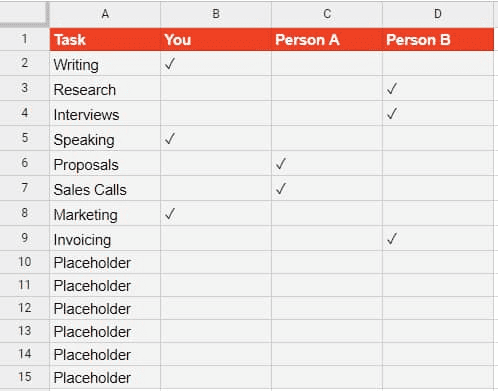
Start by listing out all the tasks you do in your business. Write down each and every task you do in your day to day. Even major tasks may consist of a series of subtasks. Include those, too. Next, list all the people (or roles, including AI) that can handle the task in question. Then, turn it into a spreadsheet, like this:
For instance, if writing is something you personally do and prefer not to outsource, think about all the aspects that go into writing — from research and ideation to editing and publishing to a blog. Thus, “writing” is really a combination of several tasks, where some (or parts of them) can be successfully relegated.
Step 2: Build Your Contractor Network
Rather than hiring full-time employees immediately, start by building a network of reliable contractors who can handle your low-value tasks. This approach provides flexibility while testing which roles are most critical to your business.
Begin with the most administrative tasks: scheduling, basic research, proposal formatting, invoice processing, and data entry. Platforms like Upwork, Fiverr, and Toptal can help you find qualified contractors for specific tasks.
As you become comfortable with delegation, expand to more complex activities like content creation, marketing support, and even specialized consulting work within your area of expertise — much like a paralegals do within a law firm, for example.
The key is developing Standard Operating Procedures (SOPs) for each delegated task. Document exactly how you would complete the work, including tools, templates, and quality standards. This documentation makes delegation more effective and helps contractors deliver consistent results.
Step 3: Build Your Bench Before You Need It
One of the biggest obstacles to scaling is the lack of capacity to handle larger projects when they arise. Many consultants hesitate to pursue significant opportunities because they don’t have the resources to deliver successfully.
The solution is building your “bench” (i.e., an established network of qualified consultants and specialists who can support larger engagements) before you need them. This preparation allows you to confidently pursue bigger opportunities knowing you can deliver on them.
Start by identifying the types of expertise you might need for larger projects. These could include project managers, subject matter experts in complementary areas, data analysts, or implementation specialists.
Develop relationships with these professionals through industry events, referral networks, and professional associations. Test their capabilities on smaller projects before committing to larger engagements.
Apply to Join Clarity Coaching™
The Coaching Program & Mastermind Community for Ambitious 6 & 7 Figure Consulting Business Founders.
Your application and initial growth session are free.
Having a robust bench provides confidence to pursue larger opportunities and creates optionality when team members are unavailable. Aim to have 2-3 qualified options for each key role.
Step 4: Productize Your Service Delivery
Productization involves standardizing elements of your service delivery to create more predictable processes, outcomes, and economics. This doesn’t mean eliminating all customization, but rather identifying the components within the delivery process that can be systematized.
Start by analyzing your past 10-20 client engagements. Look for common patterns in the problems you solve, methodologies you use, and deliverables you create. These patterns form the foundation for productized offerings.
Develop comprehensive frameworks, templates, and standardized processes that can be applied across multiple clients with only minor customization required. Look for repetitive tasks and processes that appear consistently across engagements. This might include the strategic use of diagnostic tools, implementation methodologies, or specialized training programs.
Productization creates multiple benefits: faster project delivery, easier training of team members, more predictable pricing, and the ability to scale without constant recreation of processes. The goal isn’t to eliminate all customization but to create a foundation of repeatable elements that can be tailored to specific client needs.
Leveraging AI for Competitive Advantage
The rise of artificial intelligence presents both challenges and unprecedented opportunities for consulting businesses. Forward-thinking consultants are already using AI to enhance their service delivery, improve efficiency, and create new value propositions for clients.
AI as a Force Multiplier
AI tools can dramatically increase your productivity and capability across multiple business functions. For content creation, AI can help with research, first drafts of proposals, and thought leadership articles. For data analysis, AI can process large datasets and identify patterns that would take humans much longer to discover.
Many consultants are integrating AI into their client delivery, using it to enhance research capabilities, generate insights from client data, and even create preliminary recommendations that can be refined with human expertise.
The key is viewing AI as a force multiplier rather than a replacement. The consultants who thrive will be those who combine AI capabilities with human judgment, relationship skills, and strategic thinking.
Creating AI-Enhanced Service Offerings
Some consultants are developing entirely new service lines around AI implementation and strategy. This might include helping traditional businesses integrate AI into their operations, developing AI governance frameworks, or creating AI-powered tools for specific industries.
Others are enhancing existing services with AI capabilities. For example, HR consultants might use AI to analyze employee sentiment data, while strategy consultants might leverage AI for competitive intelligence gathering.
The opportunity lies in being early to identify how AI can enhance your specific area of expertise and developing proprietary approaches that differentiate your practice.
Systematic Delegation and Team Building
As your business grows, your ability to delegate effectively becomes critical. This goes beyond just outsourcing administrative tasks to building a team that can deliver your expertise at scale. You’re on your way to create your bench, but now’s the time to start putting it into action.
Creating Systems That Enable Delegation
Effective delegation requires robust systems and processes. Start by documenting your methodologies in detail, including decision-making frameworks, quality standards, and client communication protocols.
Develop training materials that can bring new team members up to speed quickly. (This also includes creating contextual SOP documents that can preloaded into AI systems before prompting them.) This might include video tutorials, written procedures, and supervised practice opportunities.
Create feedback loops that ensure delegated work meets your standards. Schedule regular check-ins, conduct quality reviews, and develop client feedback systems help maintain consistency as you scale.
Building a Results-Oriented Culture
As you add team members, focus on creating a culture oriented around client results rather than just task completion. This means helping team members understand not just what to do, but why it matters and how it contributes to client success.
Invest in developing your team’s capabilities rather than just using them for current capacity. The consultants who scale most successfully are those who elevate their team members’ skills over time, creating even more leverage.
Developing Multiple Revenue Streams
Scaling often involves diversifying beyond traditional consulting services to create multiple revenue streams that can grow independently.
Information Products and Training
Many successful consultants develop information products, online courses, and training programs that package their expertise in scalable formats. These products can generate revenue without direct time investment and serve as lead generation tools for higher-value consulting work.
Licensing and Certification Programs
If you’ve developed proprietary methodologies, consider licensing them to other consultants or creating certification programs. This approach allows you to scale your impact and generate revenue from your intellectual property.
Strategic Partnerships
Develop partnerships with complementary service providers, technology companies, or larger consulting firms. These partnerships can provide access to larger opportunities and additional revenue streams.
Measuring and Optimizing Growth
Are you growing in the right direction? Systematic scaling requires consistent measurement and optimization of your performance. Track key metrics including:
Monthly recurring revenue and growth rate
Average project value and profit margins
Sales cycle length and conversion rates
Team utilization and productivity metrics
Client satisfaction and retention rates
Use this data to identify bottlenecks and opportunities for improvement. The most successful consultants treat their business like a system that can be continuously optimized rather than something that just happens to them.
Financial Management for Growth
Growing consulting businesses require sophisticated financial management. As you scale, you’ll need to manage things like cashflow more carefully, especially if you’re investing in team members before revenue growth materializes.
Develop financial projections that account for the lag between investment and returns. Most scaling investments take 6-12 months (or even longer sometimes) to generate positive ROI, so plan accordingly.
Consider various financing options for growth investments and expansion initiatives. Some consultants use lines of credit to bridge cashflow gaps during growth periods, while others bring in strategic partners or external investors.
The Growth Mindset: Thinking Like a CEO
Perhaps the most important factor in scaling is developing a CEO mindset rather than thinking like a consultant who happens to own a business. This means:
Strategic Thinking: Focus on building systems and capabilities rather than just completing projects. Ask yourself what your business will look like in 2-3 years and work backward from that vision.
Investment Orientation: Successful scaling requires continuous investment in people, systems, technology, and your own development. Develop comfort with spending money to make money.
Long-term Perspective: Growth takes time, and the biggest returns often come from investments that don’t pay off immediately. Develop patience for compound growth rather than seeking quick wins.
“Growth is more than just a set of marketing tactics or a ‘hack.’ It’s a mindset of continuous improvement and strategic investment.”
Common Scaling Pitfalls to Avoid
Many consultants make predictable and costly mistakes when scaling their businesses for the first time. Here are the most critical ones to avoid:
Scaling Too Fast: Growing faster than your systems and capabilities can support often leads to the potential for errors, quality problems, and client dissatisfaction. Build infrastructure before you need it.
Neglecting Culture: As you add team members and expand your operations, maintaining company culture becomes absolutely critical for long-term success. Hire for cultural fit as much as technical capabilities and expertise.
Losing Touch with Clients: Some consulting business owners become so focused on growth that they lose connection with their clients. Maintain direct client relationships even as you delegate delivery.
Inadequate Financial Planning: Many scaling efforts fail due to cash flow problems. Plan for the financial requirements of growth and secure appropriate funding.
Ready to Scale Your Consulting Business?
Scaling a consulting business requires systematic execution across multiple dimensions: business model optimization, systematic delegation, technology integration, team building, and mindset development.
The consultants who successfully scale to $1M and beyond share several common characteristics: they consistently invest in their business growth, build robust systems before they need them, proactively embrace technology including AI, and maintain unwavering focus on their strategic plan.
Your scaling journey is unique, but the principles and frameworks outlined in this guide provide a proven roadmap. The question isn’t whether these strategies work – it’s whether you’ll commit to implementing them consistently over time.
Need Help? Get Personalized Coaching
Scaling a consulting business is complex, but you don’t have to figure it out alone. In our Clarity Coaching™ program, we’ve helped over 1,000 consultants build more strategic, profitable, and scalable consulting businesses.
We’ll work hands-on with you to develop a strategic growth plan, optimize your business model, and implement the systems needed to scale effectively. You’ll learn how to generate more profit with every project, build a team that extends your capabilities, and create the leverage necessary for exponential growth.
Our coaching clients have achieved remarkable results: 4X revenue increases, 10X pricing improvements, and successful transitions from solo practitioners to seven-figure consulting firms. A third-party verification service even measured the average ROI of our members at 130% and reaching as high as 524%.
Learn about Clarity Coaching™ and schedule your free consultation call. Don’t let another year pass wondering what your business could become. Take the first step toward systematic scaling today.
FAQ About This Article
Q: What’s the difference between scaling and growing a consulting business?
A: Growing typically means adding more clients or projects linearly, while scaling means increasing revenue exponentially without proportionally increasing your time investment. Scaling involves building systems, processes, and teams that can operate independently of your direct involvement, allowing you to generate more income while working fewer hours. True scaling transforms your consulting practice from a job into a business asset.
Q: Which consulting business model is best for reaching $1M in revenue?
A: There’s no single “best” model – it depends on your goals and preferences. The firm model offers the highest scalability potential by leveraging other consultants, but requires significant investment in talent and systems. The productized model can scale efficiently through standardized offerings, while the customized model can reach $1M through high-value specialization and premium pricing. Many successful consultants combine elements from multiple models as they grow.
Q: How do I know when I’m ready to start delegating tasks?
A: You’re ready to delegate when you’re spending more time on low-value activities that prevent you from focusing on high-value work like strategic client delivery, business development, and thought leadership. Start by conducting a task audit – list everything you do and categorize by value level. If you’re doing administrative work, basic research, or proposal formatting instead of winning new clients or delivering strategic value, it’s time to delegate those tasks to contractors or assistants.
Q: How can AI help me scale my consulting business?
A: AI can serve as a force multiplier across multiple areas of your business. Use AI for content creation, research, data analysis, and generating preliminary insights that you can refine with your expertise. Many consultants are also developing AI-enhanced service offerings – like using AI for competitive intelligence, employee sentiment analysis, or creating AI governance frameworks for clients. The key is combining AI capabilities with your human judgment and relationship skills rather than viewing it as a replacement.
Q: What’s the biggest mistake consultants make when trying to scale?
A: The biggest mistake is trying to scale too fast without building proper infrastructure first. Many consultants jump between tactics, avoid investing in their business, or attempt to handle everything themselves. Successful scaling requires commitment to a strategic plan, willingness to invest in systems and people, and the discipline to focus on high-value activities while delegating everything else. Growth takes time – most scaling investments require 6-12 months to generate positive ROI.
This website uses cookies to ensure you get the best experience on our site. Learn moreHide
Privacy & Cookies Policy
Privacy Overview
This website uses cookies to improve your experience while you navigate through the website. Out of these cookies, the cookies that are categorized as necessary are stored on your browser as they are essential for the working of basic functionalities of the website. We also use third-party cookies that help us analyze and understand how you use this website. These cookies will be stored in your browser only with your consent. You also have the option to opt-out of these cookies. But opting out of some of these cookies may have an effect on your browsing experience.
Necessary cookies are absolutely essential for the website to function properly. This category only includes cookies that ensures basic functionalities and security features of the website. These cookies do not store any personal information.
Any cookies that may not be particularly necessary for the website to function and is used specifically to collect user personal data via analytics, ads, other embedded contents are termed as non-necessary cookies. It is mandatory to procure user consent prior to running these cookies on your website.