This article offers a strategic guide for consultants on effectively managing “whale” client relationships — big clients that can drive major growth but also pose risks. It summarizes the benefits and challenges of working with whales, gives practical tactics for minimizing over-reliance, and shares principles for leveraging these partnerships while sustaining independence and growth. Learn how to set boundaries, diversify clients, and use whale clients as accelerators for long-term consulting success and not as sources of risk.
Picture this: you’re scrolling through your email when you see it. It’s a message from a Fortune 500 company asking if you’re available for a major consulting engagement. Your heart skips a beat. This isn’t just any client inquiry. This is a whale client opportunity that could transform your entire business overnight.
But here’s what most consultants don’t realize until it’s too late: landing a whale client is just the beginning of a complex dance that can either propel your business to extraordinary heights or create dependencies that threaten your very survival.
After working with over 1,000 consultants through our Clarity Coaching™ program, I’ve seen both sides of this story play out countless times. Today, I’ll show you exactly how to navigate whale client relationships strategically, maximizing the incredible opportunities they offer while protecting yourself from the very real risks they create.
Table of Contents
What Makes a Client a “Whale”?
Let’s start with clarity. A whale client isn’t just any large company. They’re characterized by three key factors:
Revenue concentration: They represent a significant portion of your total income, typically 40% or more of your annual revenue.
Resource intensity: They consume a substantial amount of your bandwidth, often requiring dedicated team members or exclusive attention.
Business impact: Their presence (or absence) fundamentally changes how your business operates day-to-day.
For example, if you’re a strategy consultant and land a Fortune 500 contract that takes up 65% of your capacity and generates $400,000 annually while your total revenue is $600,000, that’s a whale client. The math is simple, but the implications are profound.
These aren’t your typical project-based clients. We’re talking about engagements that reshape your business model, influence your hiring decisions, and determine your financial future.
Why Whale Clients Are Both Blessing and Risk
The Compelling Benefits
Massive revenue injection: Whale clients can triple or quadruple your annual income almost overnight. This isn’t gradual growth. It’s transformational financial acceleration that can fund business expansion you never thought possible.
Market credibility: Landing a recognizable name client signals serious competence to your market. Other prospects think, “If they’re good enough for [Big Company], they must be exceptional.” This credibility opens doors that were previously locked.
Business growth catalyst: Many successful consulting firms trace their origin story back to their first whale client. The revenue, systems, and team-building that whale clients demand often force consultants to mature their business operations rapidly.
Operational scaling: Whale clients require you to think bigger, e.g., better processes, stronger teams, more sophisticated project management. These improvements benefit every future client.
The Hidden Dangers
Revenue concentration risk: When 60-80% of your income depends on one client, you’re essentially running a single-client consulting firm disguised as a business. Any budget cuts, leadership changes, or strategic pivots at their company can devastate your business overnight.
Opportunity cost: While you’re deep in whale client work, you’re not building your broader client base or market presence. Many consultants wake up one day to realize they’ve become completely dependent on one relationship.
Scope creep vulnerability: Large clients often have complex internal politics and changing priorities. Without clear boundaries, you can find yourself doing increasingly more work for the same fee — or worse, for free.
Team dependency: If you hire specifically to serve your whale client, what happens to those team members when the engagement ends? You’re stuck with overhead you can’t sustain.
Key Insight: The biggest risk isn’t losing a whale client. It’s building your entire business around keeping one.
Making Whale Clients Work for You
Success with whale clients isn’t about avoiding them or becoming completely dependent on them. It’s about leveraging them strategically while maintaining business independence. Here’s how:
1. Build Your Financial Foundation
The moment you sign a whale client, implement the “20-20-60 Rule”:
20% emergency fund: Save this portion in a high-interest account as your business insurance policy
20% business investment: Allocate this to growth initiatives that extend beyond your whale client
60% operational expenses: Use this for delivery, team, and immediate business needs
If your whale client pays $300,000 annually, that means $60,000 goes into savings, $60,000 funds growth investments, and $180,000 covers operations. This discipline creates breathing room and options.
2. Invest in Strategic Growth Assets
Don’t just hire bodies to handle whale client work. Invest in assets that outlast any single client relationship, such as scalable systems, intellectual property, and team development that drive sustainable growth:
Systems and processes: Implement CRM systems, project management tools, and documented methodologies that improve service delivery for all clients.
Team development: Hire people who can serve multiple clients, not just your whale. Train them on transferable skills that add value across your business.
Technology infrastructure: Invest in tools that scale your capacity beyond any single engagement. AI-powered research tools, automated reporting systems, and virtual collaboration platforms can multiply your team’s effectiveness.
Intellectual property: Document your methodologies, create proprietary frameworks, and develop thought leadership content that establishes your expertise independent of any client.
3. Master the Diversification Imperative
Here’s where most consultants fail: they get so busy serving their whale client that they stop marketing entirely. This is business suicide.
The Magic Number Exercise: Calculate exactly how many conversations with ideal clients you need monthly to hit your revenue goals. If you want $50,000 monthly revenue, your average project is worth $25,000, and you close 1 in 4 prospects, you need 8 conversations per month, i.e., just 2 per week.
Write this number everywhere. Your success depends on hitting it consistently, regardless of how busy your whale client keeps you.
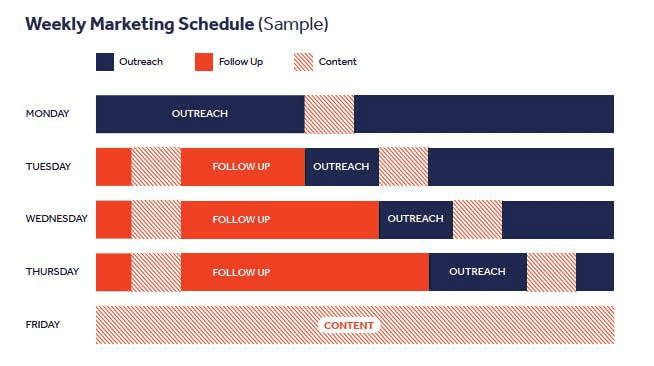
The Daily Marketing Engine: Dedicate specific time blocks to marketing activities every single day. Here’s an example daily agenda:
Morning outreach (8:00-8:30 AM): Connect with new prospects through LinkedIn or email
Follow-up activities (8:30-9:00 AM): Nurture existing relationships and previous conversations
Authority building (2:00-3:00 PM): Create content that demonstrates your expertise
Your daily list of activities will help you create conversations with your ideal clients.
Hire marketing support: Use whale client revenue to hire someone who can run your marketing engine while you focus on quality and delivery. This isn’t an expense. It’s business insurance.
Bottom line, you should always be building your personal brand and your pipeline. There’s no guarantee that you’ll be working with your whale client forever (or even as long as the contract says).
AI and the Evolving Client Landscape
Today’s whale clients face unprecedented change. AI is transforming how they operate, what they value, and what they expect from consultants.
AI as opportunity: Position yourself as the consultant who helps whale clients navigate AI transformation. Whether that’s implementing AI tools, managing AI-driven organizational change, or developing AI governance frameworks, there’s massive demand for this expertise.
AI as threat: Some whale clients are using AI to reduce their dependence on external consultants. Don’t get left behind. Stay ahead by focusing on high-level strategic work that AI can’t replicate, such as complex decision-making, stakeholder management, and creative problem-solving.
Remote relationship management: Post-2020, whale client relationships often exist primarily in virtual environments. It’s critical to master the art of building trust and delivering value through video calls, digital collaboration tools, and asynchronous communication.
Strategic Advantage: The consultants who thrive with whale clients in the AI era are those who become indispensable strategic partners, not just tactical implementers.
Proven Principles for Whale Client Success
Set Crystal-Clear Boundaries Early
Define project scope, communication protocols, and decision-making processes before work begins. Whale clients respect consultants who operate professionally, not those who say yes to everything.
Weekly boundary check: Every Friday, review the past week. Did you work beyond the agreed scope? Did the client ask for additional work without additional compensation? Address these immediately.
Create Multiple Touch Points
Don’t let your whale client relationship depend on one person. Build relationships across their organization, i.e., different departments, levels, and functions. This protects you when people leave or priorities shift.
Document Everything
Large organizations have complex internal dynamics. Document decisions, approvals, and changes meticulously. This protects you legally and helps you navigate internal politics.
Maintain External Visibility
Continue speaking at industry events, publishing thought leadership content, and engaging with your professional network. Your whale client work should enhance your market reputation, not hide it.
From Risky Dependence to Strategic Diversity
Chris Bilich’s story perfectly illustrates the strategic approach to whale clients. As an expert helping engineering firms win government contracts, Chris found himself dangerously dependent on hourly fees and a single major client.
During slow periods, his income practically vanished. Losing his sole client would have destroyed his business. But through our Clarity Coaching™ program, Chris learned to work strategically with his whale client while simultaneously building a broader client base. Specifically, he:
Shifted from hourly to value-based pricing, increasing fees by up to 40%
Diversified from one to five major clients, eliminating dangerous dependence
The result? A stable, thriving consulting business that no longer lived in fear of losing its primary client. Chris’s transformation highlights a crucial principle: the goal isn’t to avoid whale clients. It’s to leverage them while building business resilience.
The Path Forward: Confidence Through Clarity
Whale clients will always be part of the consulting landscape. The question isn’t whether you’ll encounter them, but whether you’ll be prepared to maximize their potential while protecting your business.
Success comes from approaching whale client relationships with both eyes open — seeing the incredible opportunities they represent while remaining vigilant about the risks they create.
When you build the right systems, maintain marketing discipline, and stay strategically focused, whale clients become accelerators of growth rather than sources of anxiety. You stop surviving your business and start designing it around the expert you’ve become.
Remember: confidence comes from clarity. When your positioning is sharp, your pricing is confident, and your systems support sustainable growth, whale clients enhance your business rather than define it.
Transform Your Consulting Business with Guidance
Ready to master whale client relationships while building a thriving, diversified consulting practice? The strategies in this article work, but implementation requires expert guidance and accountability.
In our Clarity Coaching program, we’ve helped over 1,000 consultants navigate complex client relationships, optimize their pricing, and build marketing engines that consistently attract ideal clients. You don’t have to figure this out alone.
Apply to Join Clarity Coaching™
The Coaching Program & Mastermind Community for Ambitious 6 & 7 Figure Consulting Business Founders.
Your application and initial growth session are free.
We’ll work hands-on with you to develop positioning that attracts premium clients, pricing that reflects your true value, and systems that support sustainable growth. Whether you’re currently managing a whale client or hoping to land one, we provide the frameworks and support you need to succeed.
Stop surviving your business and start designing it. The transformation begins with a conversation about your specific situation and goals.
Your Clarity Coaching Application Call is completely free. Schedule yours today and discover how to build a consulting business you’re proud and excited to lead.
FAQ About This Article
What exactly is a whale client?
A whale client is a large account that represents a significant portion of your consulting revenue, typically 40% or more. They’re characterized by three factors: high revenue concentration, substantial resource requirements, and major business impact. For example, if a Fortune 500 contract generates $400,000 annually while your total revenue is $600,000, that’s a whale client. These aren’t just big companies; they’re clients whose presence fundamentally changes how your business operates.
Are whale clients good or bad for my consulting business?
Whale clients are neither inherently good nor bad. They’re powerful tools that require strategic management. The benefits include massive revenue injection, enhanced market credibility, and business growth acceleration. However, they create risks like dangerous revenue concentration, opportunity costs, and potential team dependencies. Success depends on leveraging their advantages while protecting yourself from over-dependence through smart financial planning and continued marketing efforts.
How much should I save from whale client revenue?
Follow the “20-20-60 Rule”: save 20% in an emergency fund, invest 20% in business growth initiatives beyond your whale client, and use 60% for operational expenses. If your whale client pays $300,000 annually, that means $60,000 goes into savings, $60,000 funds growth investments, and $180,000 covers operations. This creates financial breathing room and strategic options if the relationship ends unexpectedly.
Should I stop marketing when I have a whale client?
Absolutely not. This is one of the biggest mistakes consultants make. Calculate your “magic number” — how many conversations with ideal clients you need monthly to hit revenue goals — and maintain that activity regardless of how busy your whale client keeps you. Consider hiring marketing support using whale client revenue. Remember, the goal is to use your whale client as a growth catalyst, not become completely dependent on them.
How do I set boundaries with demanding whale clients?
Establish crystal-clear project scope, communication protocols, and decision-making processes before work begins. Document everything meticulously and conduct weekly boundary checks every Friday to ensure you’re not working beyond agreed scope without additional compensation. Large clients respect consultants who operate professionally with clear boundaries, not those who say yes to everything. Build relationships across multiple departments to avoid depending on one internal contact.
What should I do if I lose my whale client?
If you’ve followed strategic principles, losing a whale client should be manageable rather than catastrophic. Your 20% emergency fund provides immediate cash flow protection, your diversified client base reduces revenue impact, and your continued marketing efforts should have created a pipeline of prospects. Use the transition as an opportunity to implement lessons learned and potentially pursue multiple medium-sized clients instead of seeking another single whale client.
How has AI changed whale client relationships?
AI presents both opportunities and challenges in whale client relationships. Position yourself as the consultant who helps whale clients navigate AI transformation — implementing AI tools, managing AI-driven organizational change, or developing AI governance frameworks. However, some clients are using AI to reduce consultant dependence, so focus on high-level strategic work that AI can’t replicate: complex decision-making, stakeholder management, and creative problem-solving. Master virtual relationship management since many whale client interactions now happen remotely.
This website uses cookies to ensure you get the best experience on our site. Learn moreHide
Privacy & Cookies Policy
Privacy Overview
This website uses cookies to improve your experience while you navigate through the website. Out of these cookies, the cookies that are categorized as necessary are stored on your browser as they are essential for the working of basic functionalities of the website. We also use third-party cookies that help us analyze and understand how you use this website. These cookies will be stored in your browser only with your consent. You also have the option to opt-out of these cookies. But opting out of some of these cookies may have an effect on your browsing experience.
Necessary cookies are absolutely essential for the website to function properly. This category only includes cookies that ensures basic functionalities and security features of the website. These cookies do not store any personal information.
Any cookies that may not be particularly necessary for the website to function and is used specifically to collect user personal data via analytics, ads, other embedded contents are termed as non-necessary cookies. It is mandatory to procure user consent prior to running these cookies on your website.