This article explains why strategy must come before tactics in any successful consulting business. It defines the critical difference between the two, offers a practical framework with key questions to clarify your strategic direction, and shows how to filter tactics so they genuinely advance your goals. By prioritizing big-picture thinking and leveraging AI to support (not replace) strategy, consultants can command higher fees, build deeper client relationships, and achieve lasting growth and confidence in their businesses.
Do you ever feel like you’re spinning your wheels in your consulting business? You’re busy, constantly responding to emails, chasing leads, updating your website, trying the latest marketing tool. But somehow you’re not making real progress toward your bigger goals.
It’s like running on a treadmill. Lots of movement, but you’re not actually going anywhere. This happens to more consultants than you’d think. They get caught up in the daily grind of tactics without stepping back to ask the fundamental question: “What’s my strategy here?”
And with AI tools flooding the market every day, it’s easier than ever to get distracted by shiny new tactics that promise to revolutionize your business. But here’s the thing: no tool, no matter how powerful, can fix a business that lacks strategic direction.
Your strategy comes first. Your tactics come second.
By the end of this post, you’ll have a clear framework for developing your consulting strategy and choosing the right tactics to support it. More importantly, you’ll understand why strategic thinking is what separates highly paid consultants from everyone else.
Table of Contents
The Critical Difference Between Strategy and Tactics
Let’s start with clear definitions:
Strategy: A plan of action designed to achieve a major overall aim. It’s your roadmap for where you want to go and how you’ll get there.
Tactics: Specific actions you take to execute your strategy. These are the concrete steps, tools, and techniques you use.
Think of strategy as your GPS destination and route planning. Tactics are the individual turns you make along the way.
Here’s why this distinction matters: without strategy, your tactics are just random activities. You might be busy, but busy doesn’t equal productive.
Consider this scenario: Leslie is a management consultant specializing in manufacturing companies. Her strategic goal is to implement ROI-based pricing to double her income without working more hours. That’s her strategy.
Now her tactics become clear:
Develop questions that help identify ROI for clients
Restructure proposals to highlight tangible value
Update website messaging to position herself as an authority who commands premium fees
Notice how every tactic directly supports her strategy. There’s no wasted effort.
Your Strategic Framework: The Right Questions to Ask
Most consultants skip the strategy phase because it feels abstract. They want to jump straight into action. But strategy isn’t abstract. In fact, it’s the most practical thing you can do.
Here’s your strategic framework. Work through these questions in order:
1. Destination Questions
Where do you actually want to go with your business in the next 2-3 years?
What does success look like specifically? (Revenue, lifestyle, type of work, client relationships)
What would have to be true for you to consider your consulting business a complete success?
2. Differentiation Questions
How will you differentiate your business from other consultants in your space?
What unique value do you bring that competitors can’t easily replicate?
Why should clients choose you over other options (including doing nothing)?
3. Market Questions
Who are your ideal clients? (e.g., industry, company size, role, situation)
What’s the best way to reach them consistently?
Where do they go for information and advice right now?
4. Messaging Questions
What’s the core message that will get their attention and interest?
What business problem keeps them awake at night that you can solve?
How do you want to be known in the market?
5. Positioning Questions
How will you package and position your services to resonate with ideal clients?
What transformation or outcome do clients get when they work with you?
How does your pricing model align with the value you create?
If you can’t answer these questions clearly, you don’t have a strategy yet. And that means you can’t choose the right tactics.
“Strategy serves as a filter for every decision you make. When you’re clear on your strategy, choosing tactics becomes obvious.”
How to Choose Tactics That Actually Move the Needle
Once you have strategic clarity, selecting tactics becomes straightforward. Every potential tactic gets filtered through one question:
“How does this help me fulfill my strategy?”
If it directly supports your strategy, consider it. If it doesn’t, ignore it, no matter how appealing it looks.
This applies to everything:
New marketing channels
AI tools and automation
Networking events
Content creation platforms
Pricing models
Service offerings
Let’s return to Leslie’s example. She’s focused on ROI-based pricing for manufacturing clients. When she sees a LinkedIn course about “10x Your Consulting Business with Social Media,” she asks: “Does this help me implement ROI-based pricing with manufacturing companies?”
Maybe. If the course teaches her how to share case studies about ROI she’s created for manufacturing clients, then yes. If it’s generic social media advice, then no.
The filter works.
AI and the Strategy-First Approach
Here’s where many consultants are getting tripped up right now. AI tools can help you execute tactics faster than ever before. You can create content, analyze data, automate processes, and generate insights at unprecedented speed.
But speed without direction is just faster confusion.
AI works best when you’re strategically clear about what you’re trying to achieve. Use AI to amplify your strategy, not replace strategic thinking:
Use AI for market research to refine your ideal client profile
Leverage AI to analyze competitor positioning and find differentiation opportunities
Apply AI tools to create content that supports your strategic messaging
Deploy AI automation for tactics that directly serve your strategic goals
The consultants who thrive with AI are those who use it strategically, not tactically.
Why Strategic Consulting Commands Premium Fees
There’s another crucial reason to master the strategy-versus-tactics distinction: it determines how much you can charge.
Strategy consulting — providing strategic advice and planning — is one of the highest forms of value you can offer clients.
When clients hire you for strategy, they’re paying for your thinking, judgment, and ability to see the big picture. When they hire you for tactics, they’re paying for your time and skills to implement something.
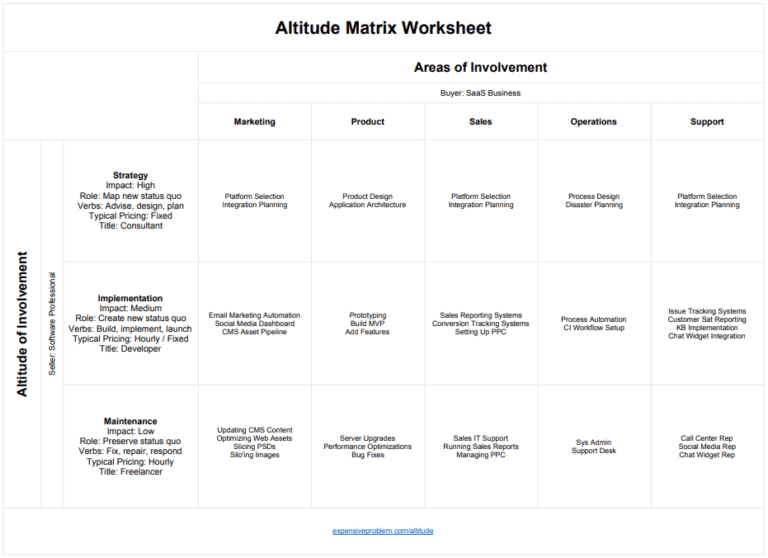
Jonathan Stark’s Altitude Matrix illustrates this perfectly. The highest altitude work is strategy. Below that comes implementation and maintenance, i.e., tactical work.
Jonathan Stark’s Altitude Matrix
The higher your altitude, the higher your fees.
Strategic consultants position themselves as trusted advisors. Tactical consultants position themselves as skilled implementers. Both are valuable, but one commands significantly higher fees.
When you help clients with strategy, you’re not just solving today’s problem. You’re helping them think through complex decisions that will impact their business for years. That’s why strategic work justifies value-based pricing and premium fees.
“Strategic thinking doesn’t just improve your business — it transforms how clients see your value and what they’re willing to pay for it.”
Your Strategy Clarity Exercise
It’s time to get specific about your own business. Grab a pen and paper (or open a document) and work through this exercise:
Part 1: Define Your Strategy Write 3-4 sentences describing your consulting strategy:
What are you trying to achieve?
What’s your long-term goal?
What does your desired future state look like?
Part 2: Audit Your Tactics List everything you’re currently doing on a daily or weekly basis:
Marketing activities
Business development efforts
Service delivery methods
Tools and systems you’re using
Part 3: Apply the Filter For each tactic on your list, ask: “How does this help me fulfill my strategy?”
If it clearly supports your strategy, keep it
If the connection is weak or unclear, consider dropping it
If it doesn’t support your strategy at all, stop doing it
This exercise often reveals that consultants are spending 60-80% of their time on activities that don’t support their strategic goals. No wonder progress feels slow.
Moving from Tactical Thinking to Strategic Leadership
The shift from tactics-focused to strategy-focused thinking doesn’t happen overnight. It requires discipline and the willingness to say no to distractions that might seem appealing.
But here’s what changes when you make this shift:
Clarity replaces confusion. When you’re strategically clear, decisions become obvious. You stop second-guessing every choice.
Efficiency replaces busy work. Strategic focus eliminates activities that don’t move the needle. You accomplish more by doing less.
Confidence replaces uncertainty. When you know where you’re going and how you’ll get there, you show up differently with prospects and clients.
Premium pricing replaces hourly billing. Strategic thinking positions you for ROI-based fees and value-based pricing models.
Most importantly, you stop feeling like you’re running in circles. Every action has purpose. Every day moves you closer to your goals.
The Strategic Consultant’s Competitive Advantage
In a world where anyone can access the same AI tools, use the same marketing platforms, and read the same business books, strategic thinking becomes your differentiator.
Clients don’t need another consultant who can implement tactics. They need someone who can help them think through complex challenges, see around corners, and make strategic decisions with confidence.
That’s the consultant who commands premium fees, builds long-term client relationships, and grows a sustainable business.
Apply to Join Clarity Coaching™
The Coaching Program & Mastermind Community for Ambitious 6 & 7 Figure Consulting Business Founders.
Your application and initial growth session are free.
When prospects ask what you do, lead with strategy. When they describe their challenges, listen for strategic opportunities. When you create content, share strategic insights, not just tactical tips.
This is how you position yourself at the top of the consulting food chain.
The consultants who figure this out build businesses they’re excited to lead. Those who don’t stay trapped in the tactical treadmill, working harder for less money.
Which one sounds like the business you want to build?
Ready to Develop Your Strategic Framework?
In our Clarity Coaching Program, we help you define your strategy first — then coach you through implementing the right tactics to achieve your goals. You’ll work with coaches who’ve built successful consulting businesses themselves and get the clarity that comes from proven frameworks, not guesswork.
When your message lands, your offer clicks, and your systems support your goals, everything changes. You stop surviving your business and start designing it.
What’s the real difference between strategy and tactics in consulting?
Strategy is your overall plan to achieve your major business goals. It’s your roadmap for where you want to go and how you’ll get there. Tactics are the specific actions, tools, and techniques you use to execute that strategy. Think of strategy as setting your GPS destination, while tactics are the individual turns you make along the way. Without strategy, tactics become random busy work that keeps you spinning your wheels.
How do I know if I need to focus on strategy or tactics right now?
If you’re constantly busy but not making real progress toward your goals, you need strategy first. Ask yourself: Can you clearly explain your business direction, ideal clients, and how you differentiate from competitors in 2-3 sentences? If not, you’re missing strategy. Once you have strategic clarity, choosing the right tactics becomes obvious because everything gets filtered through the question: “How does this help me fulfill my strategy?”
Why does strategic consulting pay more than tactical work?
Strategic consulting positions you as a trusted advisor who helps clients think through complex decisions and plan for the future. When clients hire you for strategy, they’re paying for your judgment, insights, and ability to see the big picture. Tactical work, while valuable, positions you as someone who implements what others have decided. Strategic consultants can justify premium fees and value-based pricing because they’re solving higher-level problems with longer-term impact.
Can AI tools help with strategy, or are they just tactical?
AI tools work best when you have strategic clarity about what you’re trying to achieve. Use AI to amplify your strategy, e.g., for market research, competitor analysis, content creation that supports your messaging, and automating tactics that serve your strategic goals. The mistake many consultants make is using AI tactically without strategic direction, which just creates faster confusion. AI can’t replace strategic thinking, but it can accelerate strategic execution.
What’s the biggest mistake consultants make with strategy vs tactics?
The biggest mistake is jumping straight into tactics without developing strategy first. Consultants see a new marketing tool, networking opportunity, or AI solution and immediately start implementing without asking how it fits their overall plan. This leads to scattered efforts, wasted time, and minimal progress. Always start with strategic questions about your goals, ideal clients, and differentiation before choosing any tactics.
How often should I review and update my consulting strategy?
Review your strategy quarterly to ensure you’re still on track, but avoid major changes more than once or twice per year. Your core strategic direction — who you serve, how you differentiate, your value proposition — should remain relatively stable. What might change are your tactics for executing that strategy based on what’s working, market shifts, or new opportunities. If you’re constantly changing strategy, you’re probably confusing strategy with tactics.
What AI In Consulting Really Means Everyone's focused on what AI is taking away from consulting. They're missing what it's creating. Here's why smart consultants aren't afraid of the future—they're preparing…
This website uses cookies to ensure you get the best experience on our site. Learn moreHide
Privacy & Cookies Policy
Privacy Overview
This website uses cookies to improve your experience while you navigate through the website. Out of these cookies, the cookies that are categorized as necessary are stored on your browser as they are essential for the working of basic functionalities of the website. We also use third-party cookies that help us analyze and understand how you use this website. These cookies will be stored in your browser only with your consent. You also have the option to opt-out of these cookies. But opting out of some of these cookies may have an effect on your browsing experience.
Necessary cookies are absolutely essential for the website to function properly. This category only includes cookies that ensures basic functionalities and security features of the website. These cookies do not store any personal information.
Any cookies that may not be particularly necessary for the website to function and is used specifically to collect user personal data via analytics, ads, other embedded contents are termed as non-necessary cookies. It is mandatory to procure user consent prior to running these cookies on your website.