Most consulting firm owners don't choose a structure. They inherit one by hiring in emergencies and promoting by loyalty. The three models that actually work are the solo expert, the boutique partnership, and the leveraged pyramid. Each one sets your ceiling on revenue, margin, and how much of your calendar belongs to you. Pick the model that matches the business you actually want, not the one that sounds biggest.
Your organizational structure isn't an HR diagram. It's the machine that turns your expertise into profit. A solo consultant billing 20 hours a week at premium rates can out-earn a 10-person firm bleeding money on salaries.
Most firm owners figure this out the hard way. They grow headcount because that's what scaling looks like in MBA case studies. Two years later, they're working more hours, making less per hour, and managing people instead of helping clients.
Structure decides three things. How much revenue the business can produce. How much of that revenue converts to profit. How much of your life the business consumes.
Get it right and your firm runs itself. Get it wrong and you've built a job with payroll obligations.
"Structure decides three things. How much revenue the business can produce. How much of that revenue converts to profit. How much of your life the business consumes."
Table of Contents
Three Consulting Firm Structures Worth Considering
There are a hundred org chart variations, but they collapse into three working models. Every firm we've coached falls into one of these, or into a broken hybrid trying to become one.
The Solo Expert Model
You're the firm. Your name on the door, your expertise on every engagement. You might have a virtual assistant, a fractional marketer, maybe a part-time analyst. Nobody else sits on a client call.
Fee ceiling: $150K to $750K+ per year. Margin: 60% to 80%. What it costs you: every client win and loss lands on you.
This is the highest-margin model in consulting. You're selling expertise, not labor. You can charge what your experience is worth because nobody else has it. You also cap out at your personal capacity.
This model works when your expertise is rare, your engagements are short and high-value, and you don't want to manage people.
The Boutique Partnership Model
Two to eight senior consultants, all of them working directly with clients. No analysts, no junior staff, minimal overhead. Think of the small strategy shops that compete with the Big Three on niche work.
Fee ceiling: $500K to $5M per year. Margin: 40% to 60%. What it costs you: you're a partner, not a principal. Decisions get slower.
Every partner brings their own book of business or their own specialization. Revenue grows with partners, not employees. Growth plateaus around the number of partners you can keep aligned.
This model works when your niche needs deep specialist expertise, engagements require two or three senior perspectives, and you want to scale without building layers.
The Leveraged Pyramid Model
Partners at the top, principals below, managers below that, associates at the bottom. The classic McKinsey and BCG shape. Each layer does the work the layer above used to do.
Fee ceiling: $5M to $50M+ per year. Margin: 15% to 30%. What it costs you: you stop consulting. Your job becomes sales, recruiting, and people management.
Leverage is how this model makes money. Partners sell work. Managers run it. Associates do it. Each partner profits from the work of five to ten people below them.
This model works when engagements are long, repeatable, and can be staffed by trained juniors. It breaks when clients hire you for your personal expertise and you send a 26-year-old associate to the kickoff meeting.
"Leverage is how this model makes money. Partners sell work. Managers run it. Associates do it."
Role Hierarchy Inside A Consulting Firm
If you're in the partnership or pyramid model, you need clear roles. Vague roles are how firms end up with everyone doing everyone's job and no one owning outcomes.
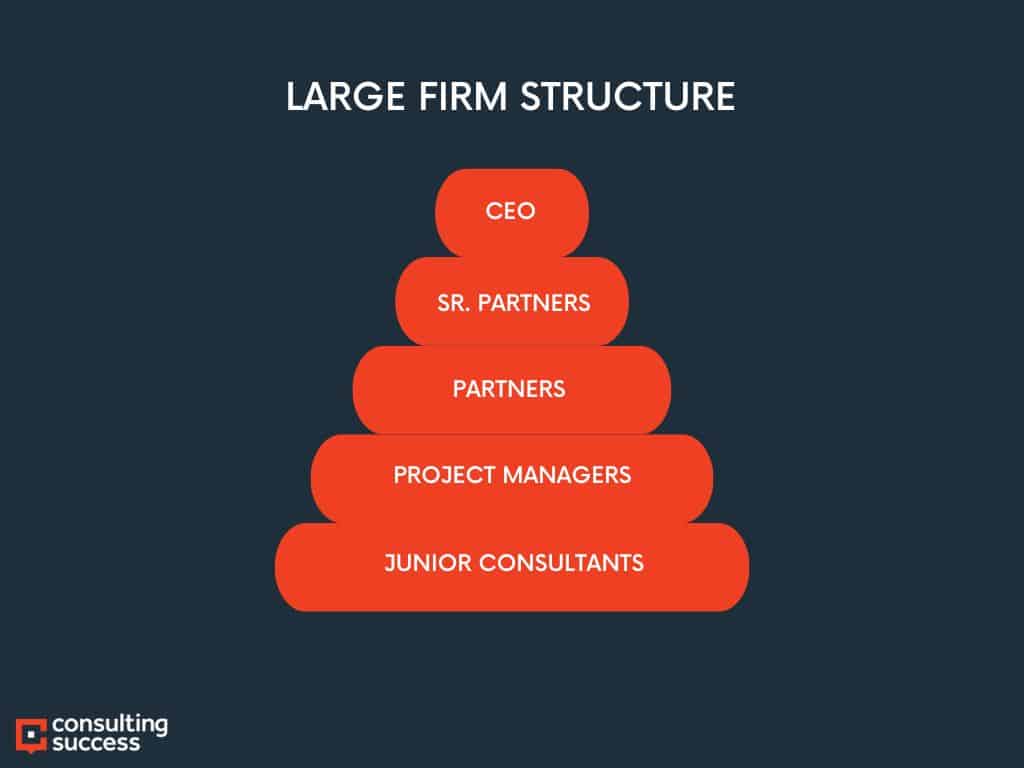
The standard hierarchy has four tiers.
Partner. Owns clients, sells work, owns P&L. Typically 10+ years of senior experience. Takes a share of profit, not a salary.
Principal or senior manager. Runs delivery on multiple engagements at once. Manages managers. Develops their own client relationships. Usually 7+ years in.
Manager or engagement manager. Runs a single engagement day-to-day. Owns the client relationship below the partner. Manages associates. Typically 4 to 7 years in.
Associate or analyst. Does the analysis, builds the decks, runs the models. 0 to 4 years in.
In a partnership, you might run with just partners and principals. In a pyramid, all four tiers are load-bearing.
Titles matter less than function. What matters is that every person knows what they own, what they're accountable for, and what career path sits in front of them.
Example large consulting firm structure. Use the titles that work for your business.
How To Know You've Outgrown Your Current Structure
Most structural problems show up as something else first. Cash flow tightens. Delivery quality slips. Your best client calls go to voicemail because you're stuck in a capacity planning meeting.
Five signs your structure isn't working:
You're turning away work you're qualified to deliver.
Your margin drops every time revenue goes up.
You're the only person who can sell, deliver, or close.
Client NPS is falling as your team grows.
You're working more hours than when you were solo.
Any two of those and you have a structural problem, not a tactical one. A new CRM or a better hiring process won't fix it.
How To Choose The Right Structure For Your Business
The right structure isn't about what McKinsey does or what sounds impressive on LinkedIn. It's about three questions most firm owners never get clear on.
What revenue ceiling do you actually want? A $500K solo practice and a $50M firm aren't the same business with more of it. They require different work, different identities, and different tradeoffs. If you want the first, don't build the second.
How much of your week do you want in front of clients? In the solo model, 60 to 80%. In a partnership, 40 to 60%. In a pyramid, 5 to 20%. Pick the percentage that fits your life, then work backward to the structure.
Do you want to sell or operate? Partners in a pyramid spend most of their time selling. Leaders in a partnership split time between selling and delivering. Solo consultants do both. None of these is better or worse. They're just different jobs inside consulting.
Most firm owners we coach pick the wrong model because they confuse ambition with design. They build a pyramid when they really wanted a partnership. They stay solo when they needed leverage. The right answer is the one that matches the life you want to live, not the one that wins at dinner parties.
"The right answer is the one that matches the life you want to live, not the one that wins at dinner parties."
Three Structural Mistakes That Cost Firms Millions
Hiring juniors to solve a senior problem. You don't have too little capacity. You have too much non-billable work. Juniors create more of it, not less. The fix is usually a fractional senior or better scoping, not another headcount.
Promoting loyalty over fit. Your best associate isn't automatically your best manager. Manager work is different work. Moving someone up because they've been around for three years is how you lose both your best producer and your next hire.
Scaling before you've cracked delivery. If your engagements still need your personal involvement to succeed, adding people won't help. You'll just manage a team that delivers at 60% of your quality. Systematize delivery first, staff second.
The Structure That Actually Supports What You Want
There's no universal right answer. There's only the structure that fits the business you want to run and the life you want to live.
If you love the craft, want 70% margins, and don't want to manage people, stay solo and raise your fees. If you love specialist work and want to grow with a few peers, build a partnership. If you want to build something you can eventually sell or run from a distance, build the pyramid. Pick deliberately.
The firms that win aren't the biggest. They're the ones where the structure, the fees, and the owner's life are all pointing in the same direction. Structure is how you get them aligned.
Ready To Build A Firm Structure That Fits Your Life
Most firm owners don't need more headcount. They need the right structure for the business they actually want.
At Consulting Success®, we've helped over 1,000 consultants design firms they're proud to lead. Our clients raise their fees within 90 days, 80% of the time. Average ROI is 130%.
Through our Clarity Coaching™ program, you'll get personalized coaching, proven frameworks, and a community of high-performing consultants who are building firms that support their life, not consume it.
During this complimentary call, we'll help you diagnose whether your current structure is the one holding you back. No pressure, no sales pitch. Just clarity on your next move.
Your expertise deserves a business that reflects it. Let's build it together.
FAQ About This Article
What is the best organizational structure for a consulting firm?
There isn't one. The right structure depends on your revenue target, how much client-facing time you want, and whether you'd rather sell or deliver. The three models that actually work are the solo expert, the boutique partnership, and the leveraged pyramid.
How many employees should a consulting firm have?
It depends on the model. A solo expert has zero full-time employees and a small network of contractors. A boutique partnership usually runs two to eight partners with minimal support staff. A leveraged pyramid can run anywhere from 20 to thousands, depending on scale.
What are the typical roles in a consulting firm?
The four standard tiers are partner, principal or senior manager, manager or engagement manager, and associate or analyst. Smaller firms compress this into two or three tiers. Larger firms add specialist functions like business development, marketing, and operations.
When should I shift from solo consultant to a team model?
When you're turning away work you're qualified to deliver, when your margin is holding but you've capped out on time, and when you actually want to manage people. If any of those three isn't true, stay solo and raise your fees instead.
What's the difference between a boutique firm and a consulting pyramid?
A boutique is built around senior consultants who all work with clients directly. A pyramid is built around leverage, where senior partners sell work that junior associates deliver. The boutique trades scale for margin. The pyramid trades margin for scale.
How much should partners make in a consulting firm?
Partners typically take a share of profit rather than a salary. In a boutique, partners often earn 40 to 60% of the revenue they personally generate. In a pyramid, profit share is tied to the performance of the whole practice, not just the partner's book.
The Hidden Cost of Hiring the Wrong Way Most consulting firm owners hire when they're overwhelmed — and end up with a team built around problems they had yesterday. The result: shrinking margins,…
Learn More About Clarity Coaching™
We transform consultants into confident consulting business owners.
This website uses cookies to ensure you get the best experience on our site. Learn moreHide
Privacy & Cookies Policy
Privacy Overview
This website uses cookies to improve your experience while you navigate through the website. Out of these cookies, the cookies that are categorized as necessary are stored on your browser as they are essential for the working of basic functionalities of the website. We also use third-party cookies that help us analyze and understand how you use this website. These cookies will be stored in your browser only with your consent. You also have the option to opt-out of these cookies. But opting out of some of these cookies may have an effect on your browsing experience.
Necessary cookies are absolutely essential for the website to function properly. This category only includes cookies that ensures basic functionalities and security features of the website. These cookies do not store any personal information.
Any cookies that may not be particularly necessary for the website to function and is used specifically to collect user personal data via analytics, ads, other embedded contents are termed as non-necessary cookies. It is mandatory to procure user consent prior to running these cookies on your website.