Most advice about building a 6 and 7 figure consulting business is built on opinion. Not here. We looked at scorecards from consultants across three revenue tiers: early six-figure, growth stage ($150K–$750K), and seven-figure+ ($1M–$5M+) and the patterns were consistent enough to be useful. The gap between tiers has less to do with marketing spend or lead volume than most consultants assume. It comes down to whether clients see you as replaceable, whether you hold your fees when someone pushes back, and whether the revenue you’re generating is actually built on anything repeatable.
Table of Contents
What separates a $150K consultant from a $750K consultant?
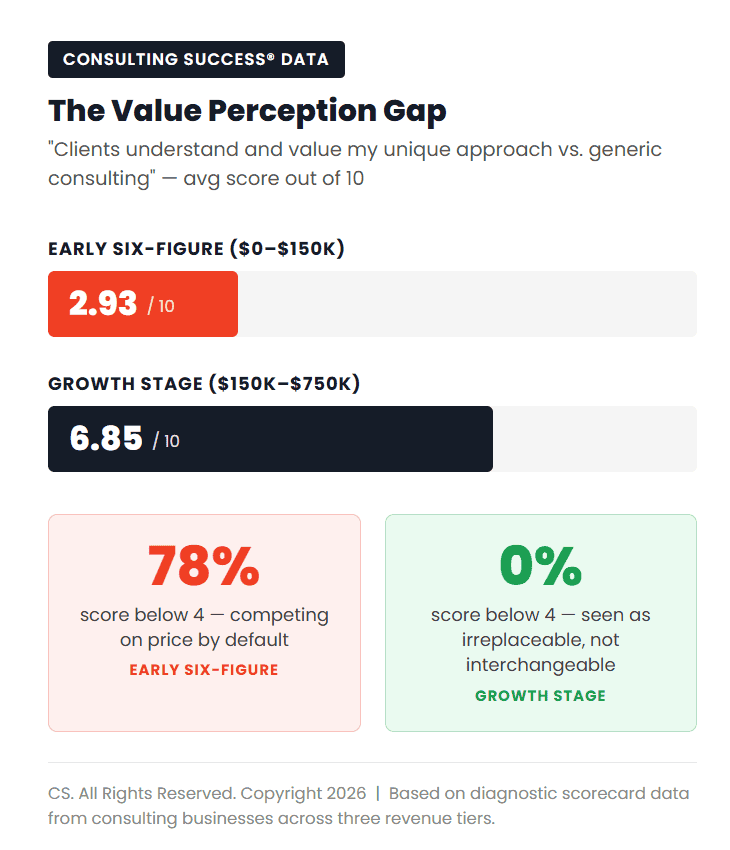
The biggest separator is value differentiation, whether clients see your approach as distinct rather than interchangeable. Early-stage consultants average 2.93/10 on this versus 6.85 for $150K–$750K consultants, a 3.92-point gap.
It’s a self-assessment: we asked consultants across both tiers to rate how well clients understand and value their unique approach. No other question in the dataset separates the two tiers as sharply.
The distribution tells the story more clearly than the average does. Among early-stage consultants, 78% scored below 4 on this question. Among growth-stage consultants, 0% did.
When clients see you as interchangeable, they shop on price. When they can’t quite picture replacing you, the pricing conversation is different. “Prospects compare me on value, not price” shows a +2.68-point gap between the same two tiers.
So how does that shift actually happen? A named methodology you can explain in plain language, case studies with specific numbers in them, and a niche narrow enough that you’re clearly the right person rather than one of several options.
One 2025 study found consultancies with a genuinely differentiated value proposition are twice as likely to achieve fast growth and high profitability. The scorecard data points the same direction.
Once revenue starts growing from that shift, something else tends to go wrong.
“The gap between six and seven figures isn’t usually a skills gap. It’s a perception gap — and the data makes it impossible to ignore.”
Why are growing consulting businesses more fragile than they look?
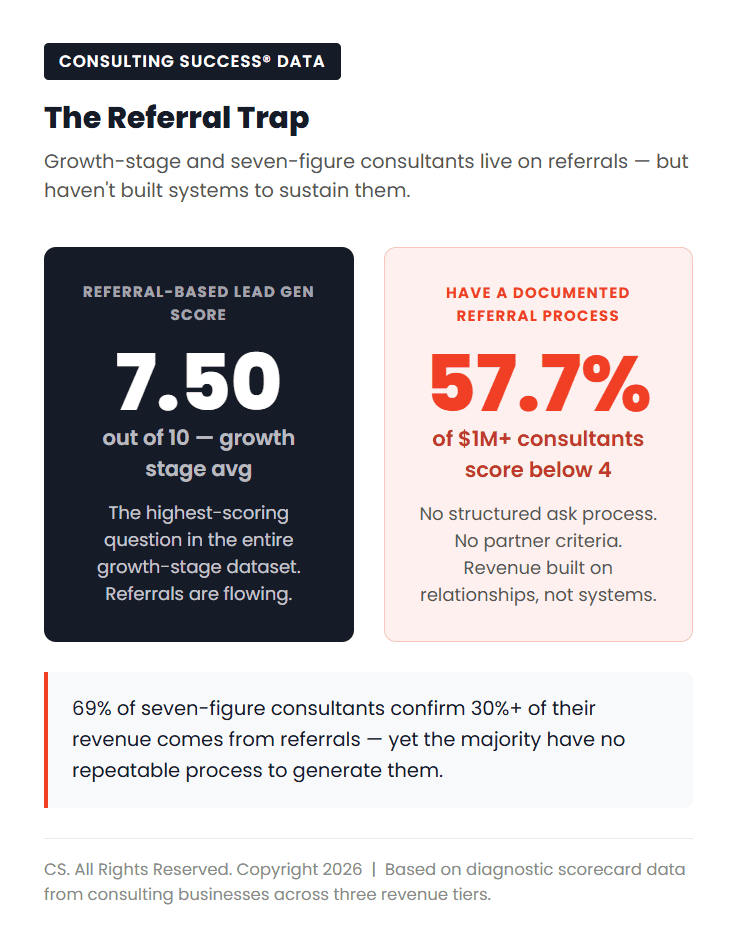
Because the revenue leans on referrals they don’t control. More than 70% rely primarily on referrals, and at the $1M+ level 57.7% have no documented process for generating them.
That combination is the fragility hiding inside what looks like a thriving consulting business. The scorecard data shows what that looks like at each tier.
Among growth-stage consultants, referral-based lead generation scores 7.50 out of 10, the highest single question score in the entire growth-stage dataset. Business is coming in. The calendar is full. From the outside, it looks like things are working.
At the $1M+ level, 69% of seven-figure consultants confirm that 30% or more of their revenue comes from referrals. At the same time, 57.7% score below 4 on having a documented process for requesting them. So more than half of seven-figure consulting businesses are generating substantial referral revenue with nothing systematic behind it.
That’s fine until it isn’t. When a key referral partner goes quiet, a longtime client exits, or a market shifts, there’s nothing to fall back on. The same tier shows a related gap: 57.7% score below 4 on documented pipeline stages, and more than 50% score below 4 on forecasting revenue within 80% accuracy. High revenue without visibility is flying without instruments.
Referrals should not be abandoned, they convert well and come pre-warmed. But there’s a meaningful difference between a business that generates referrals through reputation and one that generates them through a repeatable process.
A structured ask process, clear criteria for who makes a good referral partner, and a sense of what you’re offering them in return, those are what make referral revenue something you can plan around. For most $1M+ firms, this is the highest-impact area of marketing strategy available to them.
“Referral revenue is real. But revenue you can’t systematize isn’t a business asset — it’s a relationship you’re borrowing.”
How do 7-figure consultants hold their fees under pressure?
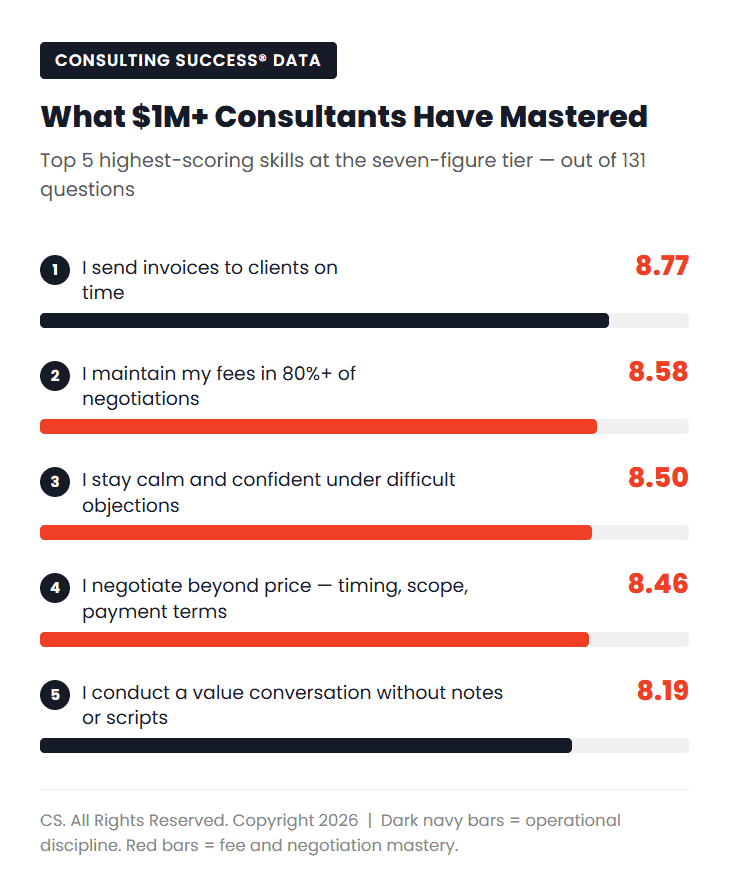
They refuse to discount and move the negotiation to scope, timing, or payment terms instead. In the data they score 8.58/10 on maintaining fees in 80%+ of negotiations, over 2 points above early-stage consultants.
The highest-scoring question across all 131 in the seven-figure scorecard is “I send invoices to clients on time” at 8.77 out of 10. Second is “I maintain my fees in 80% or more of negotiations” at 8.58. Third: “I stay calm and confident under difficult objections” at 8.50. Fourth: “I negotiate beyond price, timing, scope, payment terms” at 8.46.
The moment where most consultants lose money isn’t in their marketing or their proposal writing. It’s in the final conversation when a prospect pushes back on price. Seven-figure consultants don’t fold there. They hold the number, move the conversation onto scope or timeline or payment structure, and close at the rate they quoted.
“State fees without hesitation or apology” scores 7.07 among early-stage consultants, 7.74 among growth-stage, and 7.92 at the seven-figure level. Fee confidence grows with experience. But confidence and discipline are different things. Confidence is stating the number. Discipline is not moving it when someone looks uncomfortable.
One gap persists even at this level: “Proposals are 70% or more focused on outcomes rather than deliverables” averages 5.81 out of 10. High confidence in stating the fee, but still anchoring proposals in what gets done rather than what changes for the client. If you want to understand how to set consulting fees that actually hold under pressure, that’s where to start.
Why are 7-figure consultants slower to adopt AI than newer consultants?
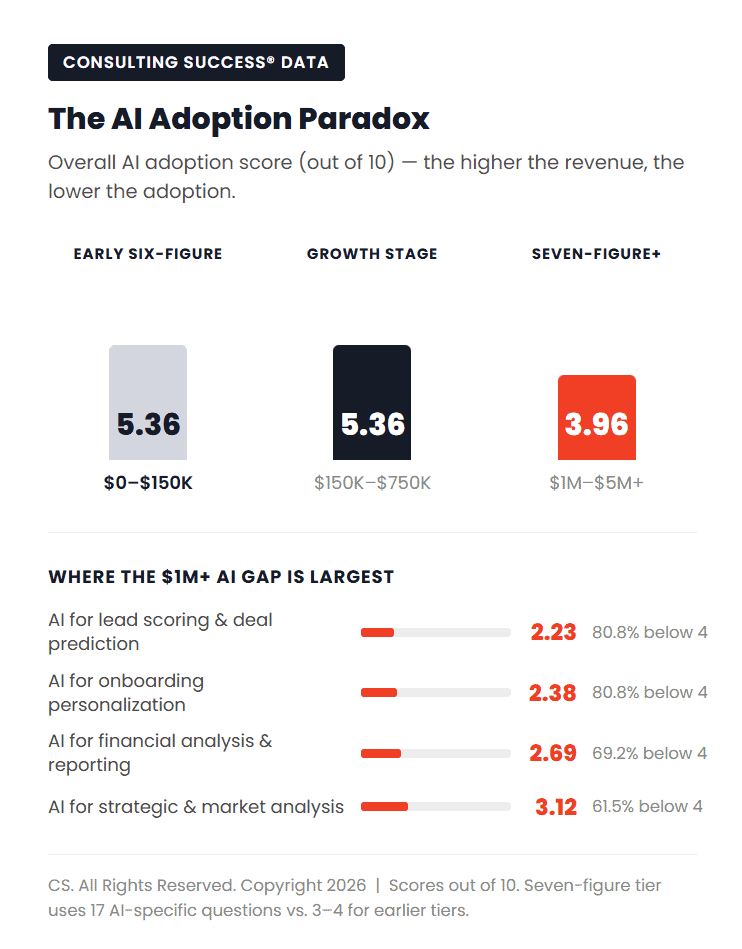
Success breeds inertia: full schedules and workflows that already work leave little appetite to change them. Seven-figure consultants average 3.96/10 on AI adoption, 1.4 points below early-stage consultants.
This is the finding that gets the most pushback. You’d expect $1M+ consulting businesses to be the most sophisticated AI adopters. The data says otherwise. The higher the revenue, the lower the adoption.
The reason isn’t surprising once you sit with it. These consultants are running full schedules. Their processes have worked for years. Introducing AI means rethinking workflows that their team has muscle memory for, and that’s a real cost when you’re also serving clients, managing a team, and running business development.
But the gap is accumulating. AI for lead scoring and deal prediction averages 2.23 out of 10 among seven-figure consultants, with 80.8% scoring below 4. AI for onboarding personalization: 2.38. Financial analysis and automated reporting: 2.69. Strategic and market analysis: 3.12.
These aren’t niche applications. They’re core business decisions that every $1M+ consulting firm makes every month. The tools exist. The question is whether waiting is a strategy or just inertia.
The least disruptive starting point: find the single process in your business that is the most manual, most time-consuming, and most obviously improvable. For most established firms, that’s either financial reporting or pipeline visibility. Start there. Nothing needs to be overhauled to make that happen.
“Seven-figure consultants have built something that works. That’s exactly why they’re slow to change it — and exactly the risk.”
Which financial metrics separate 6-figure consultants from 7-figure ones?
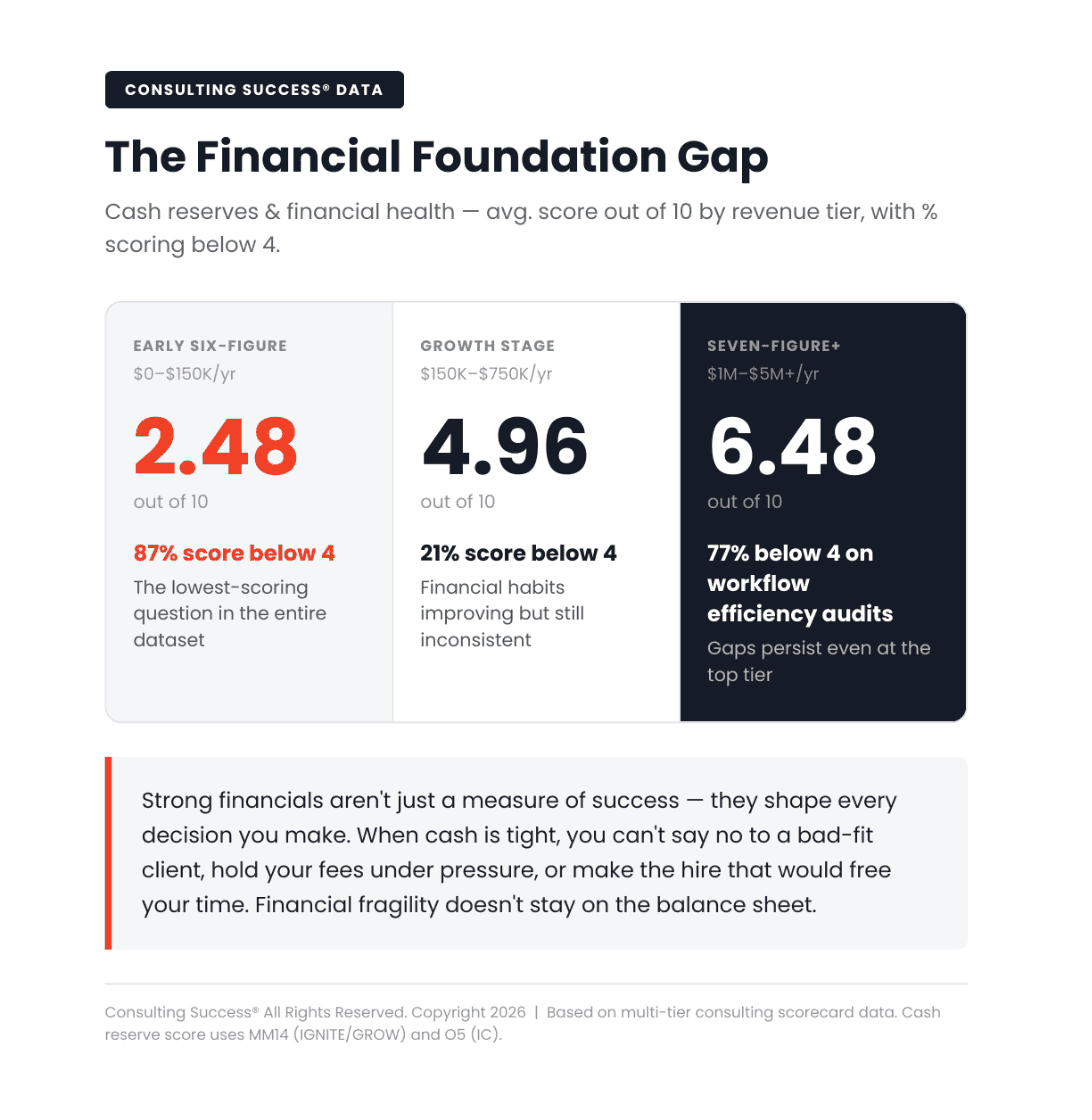
Three: profit margin, cash position versus three months of expenses, and utilization rate. Most track none, 87% of early-stage consultants score below 4/10 on cash reserves and financial data, the dataset’s lowest score.
Revenue doesn’t fix it on its own. Among seven-figure consultants, 27% still score below 4 on tracking profit margins quarterly. 31% score below 4 on having a financial dashboard with key metrics. And 77% score below 4 on having done a workflow efficiency audit in the past six months.
Industry benchmarks put gross margins for healthy consulting firms above 50% and EBITDA margins in the 20–40% range. Most consultants have no idea where they sit against those numbers, because they’re not tracking them.
When cash is tight, you can’t say no to a bad-fit client. You can’t hold your fee because you need the deal. You don’t make the hire that would free your time because the cash position doesn’t support it. Financial fragility isn’t just a balance sheet problem, it shapes every judgment call you make about clients, pricing, and growth.
Tracking even those three numbers monthly puts most consulting businesses ahead of their peers.
What does the path from six to seven figures look like?
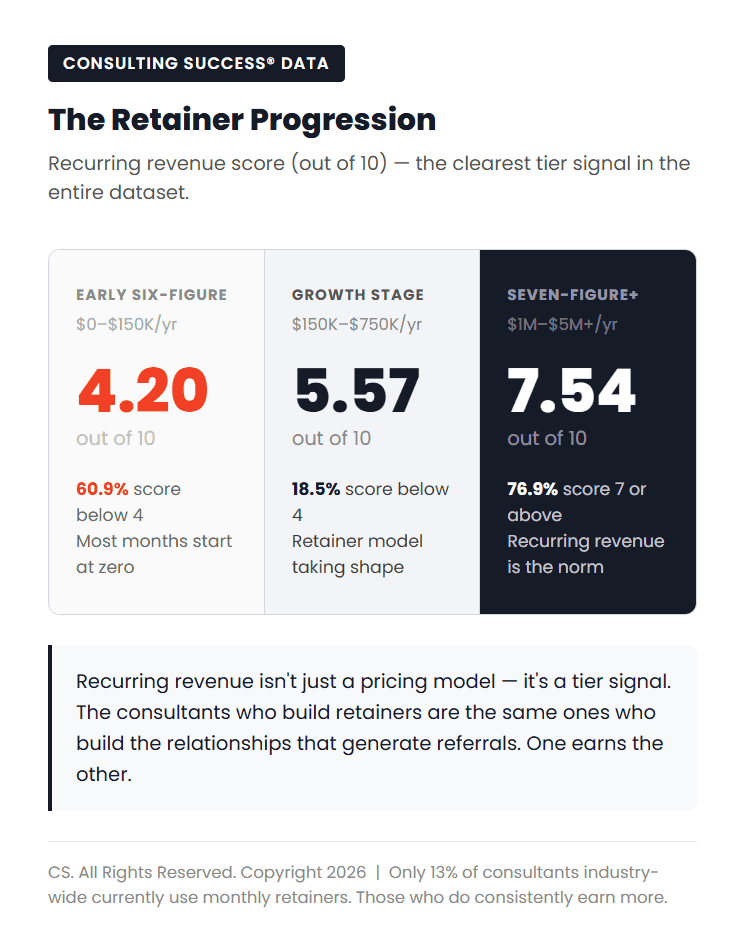
It runs through recurring revenue and repeatable systems, not more leads. Seven-figure consultants average 7.54/10 on recurring revenue (76.9% score 7+) versus 4.20 for early-stage.
The climb is steady. Growth-stage consultants land in the middle at 5.57, and this progression is one of the most consistent patterns in the entire dataset.
Only 13% of consultants currently use monthly retainers, according to industry data. But those who do earn more consistently, and the scorecard data shows the same pattern at scale. Recurring revenue isn’t just a pricing model. It’s a signal of how deeply embedded a consultant is in their clients’ world.
Retainers don’t come from offering them. They come from a client relationship where your absence would cost more than your fee. That same depth of relationship is what generates the referrals that the highest tiers rely on, which is why the highest-referral tiers in this data are also the highest-retainer tiers. They’re not two separate things.
What the data suggests about the actual path: in the early stage, the priority is getting clients to see your approach as distinct. That means a point of view you can actually articulate, case studies with real numbers, and a niche narrow enough to be credible.
In the growth stage, the work is protecting the consulting pipeline from the referral dependency that builds up quietly while things are going well. At the seven-figure level, the remaining gaps are operational, documented referral systems, pipeline visibility, financial tracking, and selective AI adoption in the areas where the return is clearest.
The consultants who make it to seven figures are not always the best marketers or the most aggressive about business development. They built the infrastructure before they needed it. That’s what the data keeps coming back to. If you’re working on scaling your consulting business, this is what it actually looks like from the inside.
The natural next question after seeing this data is what operationalizing it actually looks like. What does a documented referral system look like in practice? How do you build the financial tracking habits that compound over time? How do you restructure your sales process so fees hold? That work, turning the diagnosis into a real operating plan, is exactly what we do inside the Clarity Coaching™ program.
It’s what we’ve helped over 1,500 consulting business owners work through, one-on-one, with coaches who have built and run six, seven, and eight figure businesses themselves. We’re also working on a follow-up piece that goes deeper into the actual playbooks and systems behind these numbers. But if you don’t want to wait for an article, and you’re ready to work on this now, the next step is a conversation.
Ready to build a consulting business and reach your full potential?
The Clarity Coaching™ program is built around one principle: you should only take business advice from someone who has actually done it.
Every coach at Consulting Success has built and run a six, seven, or eight figure consulting business. They’ve had the same conversations with clients, faced the same pricing decisions, and navigated the same transitions you’re navigating now. That’s not a credential on a wall. It’s the reason the advice works.
The program is 1-to-1. Your coach works with you on your business, your gaps, your next move. And you do that inside a community of other six and seven figure consulting founders who are solving the same kinds of problems at the same level.
If you’re at the stage where generic advice isn’t cutting it anymore, this is where to go next.
During this call, we’ll help you identify exactly where your biggest leverage point is, whether that’s positioning, pricing, pipeline, or systems. No pressure. Just clarity on your next step.
FAQ About This Article
What is the most important factor in scaling a consulting business from $150K to $750K?
The most important factor is value differentiation, whether clients see your approach as distinct from generic consulting. Data shows a 3.92-point gap on this question between the two tiers, with 78% of early-stage consultants scoring below 4 out of 10 versus 0% of growth-stage consultants.
How do 7-figure consultants handle fee negotiations differently?
Seven-figure consultants maintain their fees in 80% or more of negotiations, scoring 8.58 out of 10 on this, more than 2 points above early-stage consultants. Rather than discounting under pressure, they shift the conversation to scope, timeline, or payment terms while holding the original fee.
Why are established consulting businesses more fragile than they appear?
Most rely almost entirely on referrals with no system behind them. At the $1M+ level, 69% of consultants say 30% or more of their revenue comes from referrals, yet 57.7% have no documented process for requesting them, meaning a single relationship change can significantly disrupt revenue.
Why are seven-figure consultants slower to adopt AI than newer consultants?
Seven-figure consultants average 3.96 out of 10 on AI adoption, lower than consultants at the $150K level. The reason is inertia driven by success: full schedules, established workflows, and less appetite for disrupting something that is already working, even when the tools could improve efficiency.
Apply to Join Clarity Coaching™
The Coaching Program & Mastermind Community for Ambitious 6 & 7 Figure Consulting Business Founders.
Your application and initial growth session are free.
What financial metrics should every consultant track to grow past six figures?
Consultants should track three numbers monthly: profit margin, cash position versus three months of operating expenses, and utilization rate. Industry benchmarks put healthy consulting gross margins above 50% and EBITDA margins in the 20–40% range, but most consultants don’t know where they stand.
How do consultants build recurring revenue and move to a retainer model?
Recurring revenue follows depth of client relationship, not pricing strategy. Seven-figure consultants average 7.54 out of 10 on recurring revenue, versus 4.20 for early-stage consultants. Retainers come when clients believe your absence would cost more than your fee, earned through consistent, embedded, outcome-driven work over time.
What do the most profitable consulting businesses have in common?
The highest-performing consulting businesses combine three things: clients who see them as irreplaceable (not interchangeable), fees they maintain under pressure, and revenue built on repeatable systems rather than individual relationships. Seven-figure consultants score above 8.5 out of 10 on fee discipline and negotiation confidence.
This website uses cookies to ensure you get the best experience on our site. Learn moreHide
Privacy & Cookies Policy
Privacy Overview
This website uses cookies to improve your experience while you navigate through the website. Out of these cookies, the cookies that are categorized as necessary are stored on your browser as they are essential for the working of basic functionalities of the website. We also use third-party cookies that help us analyze and understand how you use this website. These cookies will be stored in your browser only with your consent. You also have the option to opt-out of these cookies. But opting out of some of these cookies may have an effect on your browsing experience.
Necessary cookies are absolutely essential for the website to function properly. This category only includes cookies that ensures basic functionalities and security features of the website. These cookies do not store any personal information.
Any cookies that may not be particularly necessary for the website to function and is used specifically to collect user personal data via analytics, ads, other embedded contents are termed as non-necessary cookies. It is mandatory to procure user consent prior to running these cookies on your website.