This in-depth guide outlines 10 essential steps to building a client-generating consulting website — from clarifying your ideal client and crafting a magnetic message to leveraging AI, designing for trust, and optimizing for results. Learn how to turn your website into a strategic sales system that attracts, engages, and converts ideal prospects, avoiding common mistakes and building long-term authority through high-impact content and email list growth.
Your consulting website isn’t just a digital business card — it’s your most powerful 24/7 sales team member. Yet most consultants treat it like an afterthought, focusing on aesthetics over strategy, features over results.
Here’s the reality: a busy executive won’t book a call with you because you use a beautiful shade of burgundy or have the latest web animations. They’ll reach out because your website immediately shows them you understand their challenges and can solve their problems.
This comprehensive guide will walk you through building a consulting website that doesn’t just look professional — it actually generates leads, positions you as the expert you are, and creates meaningful conversations with your ideal clients.
Table of Contents
Why Your Website Strategy Matters More Than Ever
The consulting landscape has changed dramatically. With AI democratizing information and more consultants entering the market daily, your website needs to do more than exist — it needs to differentiate you from the noise.
Consider this: when a potential client searches for your name or your area of expertise, whether it’s a search engine or an AI tool, your website is often their first impression of your consulting practice. Within five seconds, they’ll decide whether you’re worth their time or if they should click away to your competitor.
That five-second window isn’t about fancy graphics or smooth transitions. It’s about clarity, credibility, and connection. Your website needs to immediately answer the question: “Is this person the right consultant to solve my specific problem?”
Step 1: Define Your Foundation Before You Build
Understand Your Ideal Client Profile
Before you write a single word or choose a color scheme, you must be crystal clear about who your website serves. This isn’t about you — it’s about your ideal client.
Effective consulting websites target a specific person. If you’re not clear about your ideal client before building your website, you’ll end up with something scattered, generic, broad, and unconvincing.
Look at successful consultants like Nic Campbell, who works exclusively with nonprofit and philanthropic organizations, or Jason Fearnow, who focuses on mining companies and executives. Their websites speak directly to their target audience because they know exactly who they’re talking to.
The more specific your ideal client, the more compelling your website becomes. A general “business consultant” website will always lose to one that says “I help manufacturing companies reduce operational waste by 40% in 90 days.”
Ask yourself these questions:
What specific industry or type of organization do you serve best?
What’s the typical role or title of your decision-maker?
What keeps them awake at night?
What does success look like for them?
How do they prefer to consume information?
Craft Your Magnetic Message
Your Magnetic Message is the foundation of your entire website. It’s not your elevator pitch — it’s the clear, compelling statement that makes your ideal client think, “This person gets exactly what I’m dealing with.”
A powerful Magnetic Message includes:
Who you serve (specifically)
What problem you solve
The outcome you deliver
A timeframe (when possible)
Instead of “I help businesses improve efficiency,” try “I help manufacturing leaders eliminate operational bottlenecks and increase productivity by 35% within 120 days.” This specificity doesn’t limit you — it attracts the right clients while naturally filtering out poor fits for your consulting business.
Step 2: Plan Your Website Architecture
Think of your website as a strategic sales system where each page has a specific job. Just as you wouldn’t send a junior associate to close a seven-figure deal, you shouldn’t expect your About page to do the work of your Services page.
The Six Essential Pages Every Consulting Website Needs
Homepage: Your First Impression Expert Your homepage acts like the charismatic team member who greets potential clients and guides them where they need to go. Within five seconds, visitors should know whether your services are right for them.
About Page: The Relationship Builder This page builds trust through authentic storytelling. It’s not just sharing facts — it’s weaving a narrative that resonates with your ideal clients while letting poor fits know they’re better served elsewhere.
Services Page: The Solutions Expert Your services page matches prospects with the perfect solution for their needs. Present each service like a solutions consultant would frame a recommendation, focusing on problems solved and outcomes delivered.
Case Studies Page: The Success Story Specialist This page showcases tangible proof that you deliver results. Each case study should follow the problem-process-payoff structure, making it easy for prospects to see themselves in your success stories.
Blog Page: The Content Marketing Specialist Your blog demonstrates expertise through valuable insights while attracting prospects through search engines. Think of each post as a mini-consulting session that showcases your problem-solving approach.
Free Consultation Page: The Appointment Setter This page has one mission: convert interested prospects visiting your website into booked meetings. Make the booking process frictionless while clearly articulating the value of speaking with you.
“Your website isn’t just a collection of pages — it’s a carefully orchestrated journey that guides potential clients toward working with you.”
Step 3: Write Website Copy That Converts
Writing is often the most challenging part of creating an effective consulting website, but it’s also the most important. Your copy and messaging will persuade ideal clients to reach out, not fancy design elements.
Homepage Copy Strategy
Start with a powerful hero section (the top section of your website, often called “above the fold”) that includes your Magnetic Message. Follow this with:
Client logos or impressive references
Clear understanding of their pain points
Overview of your expertise with specific examples
Social proof through testimonials
Recent thought leadership or case studies
Brief background establishing credibility
Clear next steps with compelling calls-to-action
Each section should naturally lead to the next, like a skilled salesperson guiding a conversation. Some copywriters refer to each section as part of a “bucket brigade.”
Make It About Them, Not You
One of the biggest mistakes consultants make is creating websites that focus entirely on themselves. Instead, make your website about your client.
Talk about their challenges, objections, frustrations, and desired outcomes. Make it read like a page from their diary. Show them you understand what they’re dealing with now and where they want to be.
Once you’ve demonstrated that understanding, then position yourself as the bridge that can take them from their current state to their desired future.
Leverage Social Proof Throughout
There’s nothing wrong with highlighting your expertise and results — you should do that. But back it up with credible social proof:
Detailed case studies with specific metrics
Client testimonials with photos and full names
Logos of organizations you’ve worked with
Media mentions and speaking engagements
Professional certifications and credentials
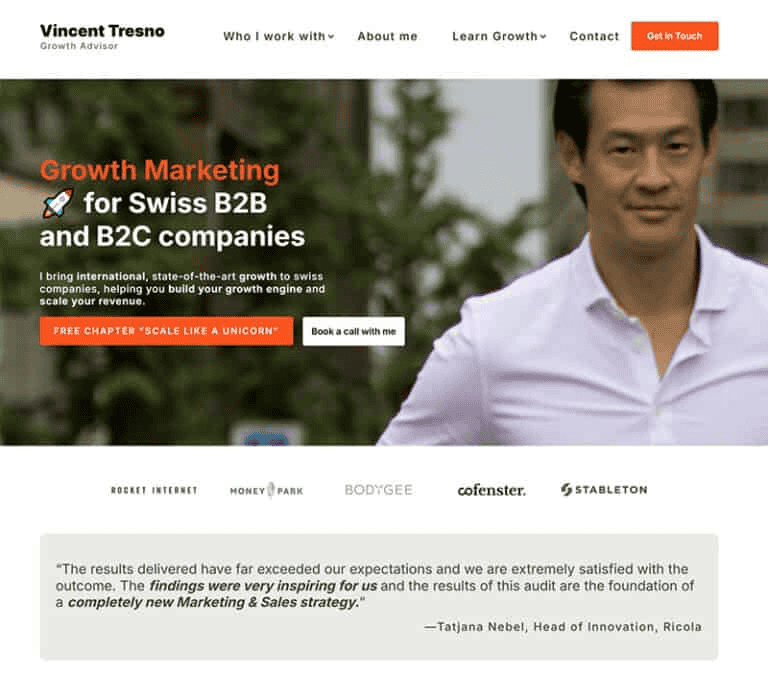
Vincent Tresno’s website excellently demonstrates this approach, featuring client logos prominently and weaving testimonials throughout his content rather than relegating them to a single section.
Step 4: Design for Trust and Usability
While messaging trumps aesthetics, design still matters for credibility and user experience. Your website should look professional and be easy to navigate, especially on mobile devices.
Mobile-First Design is Non-Negotiable
With over 80% of internet users owning smartphones and many executives doing initial research on mobile devices, your website must work flawlessly across all devices. Google has been penalizing non-mobile-friendly websites since 2015, making responsive design essential for both user experience and search visibility.
Test your current website using Google’s Mobile-Friendly Test tool. If it fails, prioritize making your site responsive immediately.
Visual Trust Elements
Your design should immediately establish credibility through:
Professional photography (especially of yourself)
Clean, uncluttered layouts with plenty of white space
Consistent branding that reflects your expertise level
Easy-to-find contact information
Professional email addresses (not Gmail or Yahoo)
Physical address to establish legitimacy
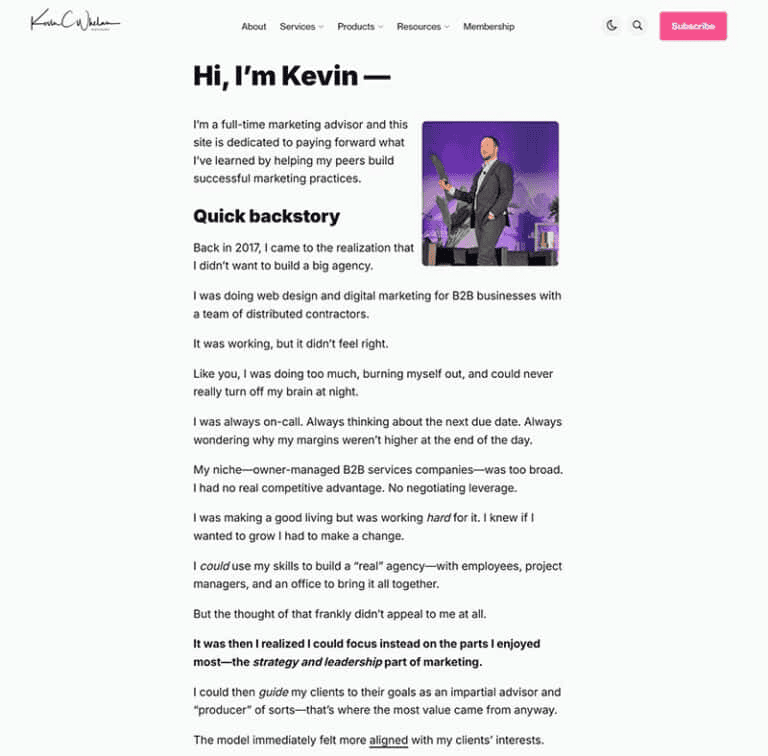
Kevin C. Whelan’s website demonstrates excellent use of professional photography and clean design that immediately establishes trust and authority.
Avoid Information Overload
Your website should guide visitors smoothly toward taking action, not overwhelm them with choices. Every element should have a clear purpose.
Avoid the mistakes of showing confusing pricing displays, unclear service offerings, or mixed messages. If visitors can’t quickly understand what you do and how to work with you, they’ll leave for a competitor who makes it crystal clear.
Step 5: Launch Your Minimum Viable Website
Choose the Right Platform
For most consultants today, managed platforms like WordPress, Squarespace, Webflow, or Wix provide excellent solutions without requiring technical expertise. WordPress remains our top recommendation due to its flexibility, SEO capabilities, and extensive customization options.
When selecting hosting, prioritize:
Reliability and uptime
Customer service quality
Ease of use
Scalability for growth
If you’re looking to manage your own content management system and prefer a self-managed platform, then services like LiquidWeb, BlueHost, GoDaddy, or HostGator meet these criteria while remaining affordable for most consulting practices.
Don’t Build It Yourself
Unless you’re a professional designer or the host provides easy-to-use design tools and templates, hire someone with experience creating consulting or professional services websites. Platforms like Upwork and Fiverr offer access to talented designers who understand the consulting industry’s unique needs.
Your role is to guide the designer in creating a website that’s compelling to your ideal clients, not just visually appealing to you. Your website is a sales tool, not a brochure.
Launch When It’s “Good Enough”
Perfectionism kills more consulting websites than poor design ever will. You’re probably not going to get a flood of inquiries immediately after launch — it takes time to build momentum.
Get the basics right, then launch your website. You can always add case studies, blog content, and lead magnets after going live. The key is starting the iterative improvement process based on real market feedback.
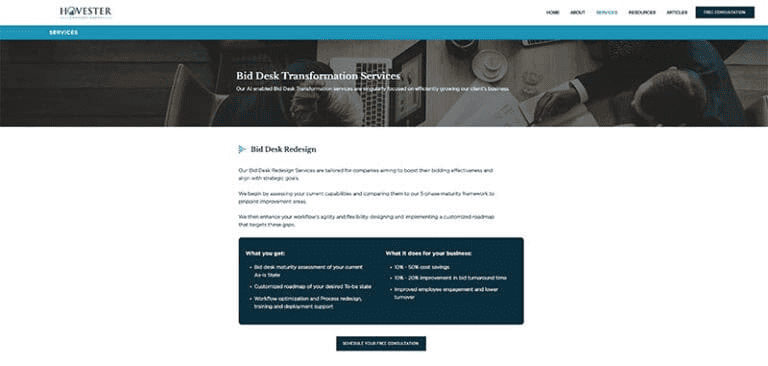
Hovester’s website demonstrates this approach — they launched with core functionality and have continuously refined based on client feedback and results.
Step 6: Leverage AI to Optimize Your Website
Artificial intelligence has revolutionized how consultants can approach website creation and optimization. You no longer need extensive technical knowledge or huge budgets to create professional, effective websites.
AI Tools for Website Creation
Modern AI platforms can help you:
Generate compelling copy based on your expertise and target market
Create professional images and graphics
Optimize content for search engines
Design layouts that convert visitors into leads
Analyze user behavior and suggest improvements
Tools like ChatGPT can help draft initial website copy, while platforms like Canva’s AI features can create professional graphics. But remember, AI should enhance your expertise, not replace your strategic thinking about positioning and messaging.
Showcasing AI Integration in Your Services
If you use AI tools in your consulting work and delivery, your website should demonstrate this competitive advantage. Consider adding:
Case studies showing how AI helped deliver better client outcomes
Blog content about AI applications in your specific industry
Service descriptions that highlight your AI-enhanced methodologies
Thought leadership about the future of your field with AI integration
Regardless of your specialty or type of consulting, highlighting how you leverage AI in your methodology and the results it can helps generate differentiates you as a modern consultant who delivers enhanced value through technology.
Apply to Join Clarity Coaching™
The Coaching Program & Mastermind Community for Ambitious 6 & 7 Figure Consulting Business Founders.
Your application and initial growth session are free.
Step 7: Test and Optimize for Better Results
Your website should never be “finished.” Continuous testing and optimization ensure it keeps generating better results over time.
Four Critical Tests for Consulting Websites
1. Call-to-Action Effectiveness Test different button colors, text, and placement. Big changes can often lead to big improvements. But even small changes can impact conversion rates. One study showed a 21% increase in clicks by changing button color from green to red.
More importantly, test the value proposition of your call-to-action. Instead of generic “Learn More” or “Contact Us” buttons, try specific calls to action, like “Get Your Free 30-Minute Strategy Session.”
2. Value Proposition Clarity Your homepage value proposition should immediately tell visitors who you serve, what you do, and how you help. Test different versions to see which ones resonates most with your target market.
Compare a generic statement like “Business Consulting Services” with something specific like “We Help Manufacturing Leaders Reduce Operational Costs by 25% in 90 Days.” The specific version will always outperform the generic one.
3. Content Performance Use analytics to understand which content your audience prefers:
Length (do they prefer detailed guides or quick tips?)
Topics (which subjects generate most engagement?)
Format (articles, videos, podcasts, infographics?)
Offers (which lead magnets convert best?)
This data helps you create more of what works and eliminate what doesn’t.
4. Lead Magnet Effectiveness Test different lead magnets to build your email list:
Industry-specific guides
Templates and frameworks
Video training series
Assessment tools
Remember, your email list is often more valuable than your website traffic. Most clients come through ongoing email relationships, not single website visits.
“Most of the clients you get online won’t come through your website — they will come through your email list.”
Pop-Up Testing
Pop-ups may feel intrusive, but they’re effective — boosting email sign-ups by up to 400% when implemented thoughtfully. You can choose between subtle, unobtrusive designs or bold, attention-grabbing formats.
Test different approaches including:
Timing (immediate vs. delayed)
Design (branded vs. generic)
Offers (what value do you provide?)
Size (attention-grabbing vs. overwhelming)
Mobile traffic can account for over 70% of total web traffic. So ensure your pop-ups work well on mobile devices, where most of your traffic likely originates.
Step 8: Create Content That Builds Authority
Your website isn’t just a digital brochure — it’s a platform for demonstrating and selling your expertise, and building relationships with potential clients.
Publish Thought Leadership Consistently
Regular content publication serves multiple purposes that work together to build your consulting practice and establish market authority:
Demonstrates your expertise to potential clients
Improves search engine rankings
Provides material for social media and email marketing
Creates opportunities for speaking and media appearances
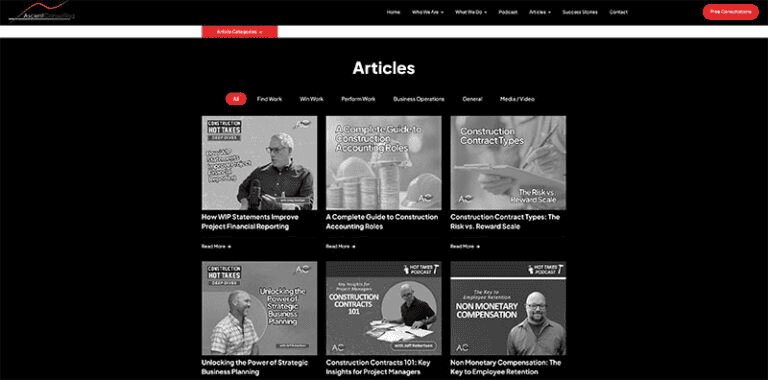
Ascent Consulting’s blog exemplifies this approach, consistently sharing valuable insights and practical frameworks that position them as trusted thought leaders.
Content That Converts
Focus on creating content that directly addresses your ideal clients’ challenges while showcasing your expertise and unique methodology:
Solves real problems your ideal clients face
Showcases your unique approach and methodology
Includes specific examples and case studies
Ends with clear next steps for engagement
Each piece of content should feel like a valuable mini-consulting session that solves immediate problems while leaving readers wanting more detailed help.
Integrate AI into Your Content Strategy
Artificial intelligence can help streamline and expedite your content creation process, and it can enhance your strategic approach in several key ways:
Generate content ideas based on trending topics in your industry
Create first drafts that you can refine and personalize
Optimize content for search engines
Repurpose content across multiple formats
Analyze performance and suggest improvements
However, always add your unique perspective, real-world experience, and strategic expertise to ensure authenticity. AI should accelerate your content creation process, not replace your strategic insights and personal voice.
Step 9: Make It Easy for Prospects to Come Forward
The ultimate goal of your consulting website is to generate conversations with ideal clients. So make it easy for them to take the next step and remove every possible barrier to that happening. Here are some key suggestions.
Streamline Your Consultation Process
The ultimate goal of your consulting website is to generate meaningful conversations with ideal clients who are ready to invest in your expertise, so remove every possible barrier to that happening.
Clearly explains the value of speaking with you
Describes what prospects can expect from the call
Uses an embedded calendar tool for easy scheduling
Includes testimonials from others who found the consultation valuable
Removes navigation and other distractions
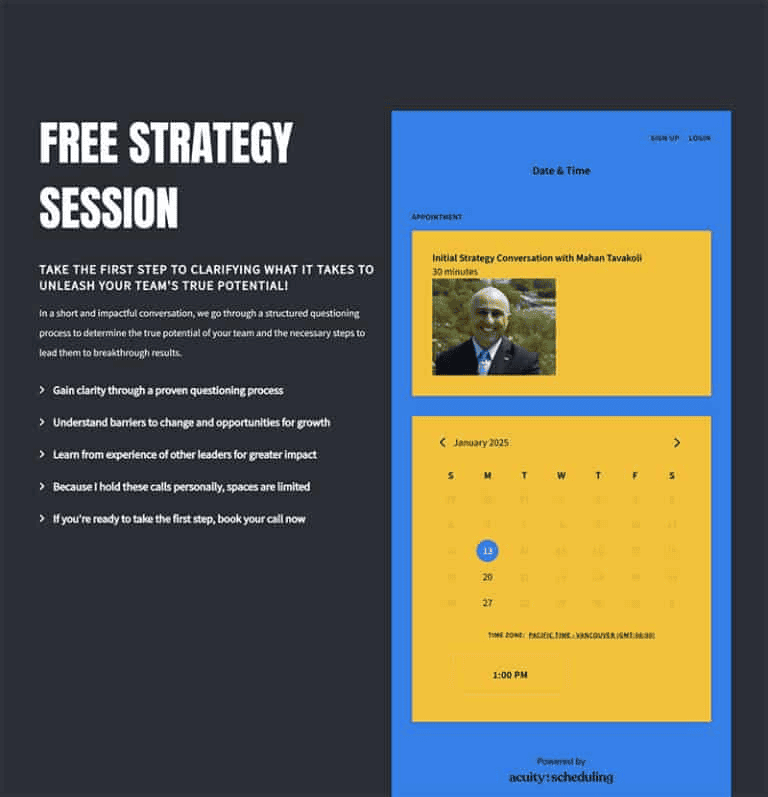
Mahan Tavakoli’s consultation page is a great example, focusing on the value proposition and booking process without distractions or competing calls-to-action.
Multiple Contact Options
Different prospects prefer different communication methods based on their personality, schedule, and decision-making style, so offer multiple ways to connect:
Phone numbers prominently displayed
Professional email addresses
Contact forms for detailed inquiries
Calendar booking links
Social media connections
Make your contact information easily accessible on every page of your website — don’t hide it behind confusing menu links or complex navigation structures.
Step 10: Build Your Email List for Long-Term Success
Email marketing consistently delivers the highest ROI of any digital marketing channel for consultants. Your website’s primary goal is to generate leads, and that includes building an email list of potential clients.
Create Irresistible Lead Magnets
Offer valuable resources that solve specific problems in exchange for your prospects’ contact information. These are called “lead magnets,” like:
Industry-specific guides and reports
Templates and worksheets
Video training series
Assessment tools and calculators
Exclusive research or insights
Ensure your lead magnets directly relate to the specific services you offer and address the exact problems your ideal clients face on a daily basis.
Email List Growth Strategies
Go beyond offering lead magnets by actively grow your email list through multiple touchpoints and strategic relationship-building opportunities, such as:
Content upgrades for popular blog posts
Speaking engagement follow-ups
Networking event connections
Partnership collaborations
Referral programs
Remember, quantity is less important than quality. A smaller list of highly engaged prospects is more valuable than a large list of uninterested subscribers.
Common Website Mistakes That Kill Conversions
Avoid these critical errors that consistently prevent consulting websites from generating qualified leads and converting visitors into prospects:
Generic Messaging: Trying to appeal to everyone appeals to no one. Be clear and specific about who you serve and what problems you solve.
Hidden Contact Information: If prospects can’t easily find how to reach you, they’ll go to a competitor who makes it more obvious to do so.
No Clear Value Proposition: Website visitors should immediately understand who you serve, what you do, and why they should care.
Outdated Content: Stale blog posts, outdated references, and old case studies suggest you’re out of touch and not actively growing your business.
Poor Mobile Experience: With the vast majority of traffic coming from mobile devices, a poor mobile user experience kills credibility instantly.
Overwhelming Choices: Offering too many options only paralyzes prospects, so guide them toward taking one clear next step.
Measuring Your Website’s Success
You don’t need to be an analytics engineer to learn how productive your website is. Simply track these key metrics to understand your website’s performance:
Traffic Sources: What channels are your best visitors coming from?
Time on Page: Are visitors interested in and engaged with your website?
Conversion Rates: What percentage of visitors take your desired actions?
Lead Quality: Are website leads converting into actual paying clients?
Search Rankings: Are you visible when ideal clients search for solutions?
Use Google Analytics and other analytics tools to gather this data, but focus on metrics that directly relate to business growth, not just vanity numbers.
The Future of Consulting Websites
The consulting industry, like technology and largely because of it, continues to evolve rapidly. Your website strategy should account for these emerging trends:
AI Integration: Clients expect consultants to leverage technology for better outcomes. Showcase your AI capabilities and methodologies.
Video Content: Video builds trust faster than text. Consider adding video testimonials, case study presentations, and thought leadership content.
Interactive Elements: Calculators, assessments, and interactive tools can increase engagement, lead generation, and lead quality.
Personalization: Dynamic content that adapts to visitor behavior creates more relevant experiences, such as showing targeted offering based on articles read.
Voice Search Optimization: As voice search grows, optimize content for conversational queries by focusing less on keywords and more on topics and questions your ideal clients ask.
“An effective consulting website isn’t static. It’s something you iterate and improve upon as you get honest feedback from the market.”
Your Website as a Client-Generation System
Building a client-generating consulting website isn’t about having the prettiest design or the most features. It’s about creating a strategic system that clearly communicates your value, builds trust with ideal clients, and makes it easy for them to take the next step.
The consultants who consistently attract high-value clients through their websites understand this fundamental truth: your website is a marketing asset, not just a digital brochure. It should work 24/7 to position you as the obvious choice for your ideal clients’ specific challenges.
The framework outlined in this guide has helped hundreds of consultants transform their websites from cost centers into profit centers. Some have doubled their inquiry volume within 90 days. Others have attracted their highest-value clients ever through strategic positioning and clear messaging.
But knowing the framework is just the beginning. The real difference comes from implementation — from actually building these pages in a way that turns your website into a client-generating powerhouse.
If you’re ready to transform your consulting website from a collection of disconnected pages into a seamless client-generation system, we’d love to help. Our Clarity Coaching™ program has guided over 1,000 consultants through this exact process, helping them create websites that don’t just look professional — they actually generate leads, build authority, and attract ideal clients.
Inside Clarity Coaching™, you’ll get the proven templates, frameworks, and personalized guidance to build a website that works as hard as you do. Plus, you’ll join a community of serious consultants who are all building businesses on purpose, with the support and accountability that makes transformation stick.
Q: How long does it take to build an effective consulting website?
A: You can launch a “minimum viable website” within 2-4 weeks if you focus on the essentials first. The key is avoiding perfectionism and getting the core pages live: homepage, about, services, case studies, and contact. Your website doesn’t need to be perfect from day one — it needs to be functional and clearly communicate your value proposition.
After launch, plan for ongoing optimization and content addition over the following months. Most successful consulting websites evolve continuously based on real market feedback and client interactions, rather than trying to anticipate every need upfront.
Q: Should I build my website myself or hire a professional?
A: Unless you’re a professional designer or using a platform with excellent templates, hire someone with experience creating consulting websites. Your time is better spent on client work and business development rather than wrestling with technical details and design decisions.
When hiring, focus on finding someone who understands professional services marketing, not just web design. Your website is a sales tool, not an art project. Platforms like Upwork and Fiverr offer access to talented designers who specialize in consulting and professional services websites.
Q: What’s the most important element of a consulting website for generating leads?
A: Your messaging is the most critical element — specifically your ability to clearly communicate who you serve, what problems you solve, and the specific outcomes you deliver. Design matters for credibility, but messaging drives conversions. Most consultants fail because they create generic websites that try to appeal to everyone instead of speaking directly to their ideal client’s specific challenges.
Focus on crafting a “Magnetic Message” that makes your target client think, “This person gets exactly what I’m dealing with.” Once you have compelling messaging that resonates with your market, everything else — from design to lead magnets — becomes much more effective.
Q: How do I know if my consulting website is actually working?
A: Track these key metrics: conversion rate from visitor to consultation booking, quality of leads generated (are they your ideal clients?), and time visitors spend engaging with your content. Don’t get distracted by vanity metrics like total traffic — focus on whether your website is attracting and converting the right prospects.
The ultimate test is simple: are you getting consultation requests from people who fit your ideal client profile and have budgets for your services? If your website isn’t generating qualified conversations with potential clients within 90 days, you likely need to refine your messaging, value proposition, or call-to-action strategy.
Apply to Join Clarity Coaching™
The Coaching Program & Mastermind Community for Ambitious 6 & 7 Figure Consulting Business Founders.
Your application and initial growth session are free.
Q: Do I really need a blog on my consulting website?
A: Yes, but only if you’re committed to publishing valuable content consistently. A blog with one post from six months ago actually hurts your credibility more than having no blog at all. However, regular thought leadership content serves multiple purposes: it demonstrates expertise, improves search rankings, provides social media material, and creates opportunities for speaking engagements.
If you’re going to blog, focus on solving real problems your ideal clients face while showcasing your unique methodology. Each post should feel like a valuable mini-consulting session. If you can’t commit to at least monthly publishing, consider starting with case studies and client success stories instead, which are often easier to create and equally powerful for building authority.
This website uses cookies to ensure you get the best experience on our site. Learn moreHide
Privacy & Cookies Policy
Privacy Overview
This website uses cookies to improve your experience while you navigate through the website. Out of these cookies, the cookies that are categorized as necessary are stored on your browser as they are essential for the working of basic functionalities of the website. We also use third-party cookies that help us analyze and understand how you use this website. These cookies will be stored in your browser only with your consent. You also have the option to opt-out of these cookies. But opting out of some of these cookies may have an effect on your browsing experience.
Necessary cookies are absolutely essential for the website to function properly. This category only includes cookies that ensures basic functionalities and security features of the website. These cookies do not store any personal information.
Any cookies that may not be particularly necessary for the website to function and is used specifically to collect user personal data via analytics, ads, other embedded contents are termed as non-necessary cookies. It is mandatory to procure user consent prior to running these cookies on your website.